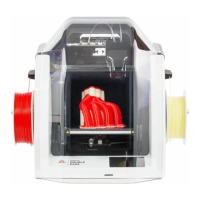
Low costs, no thermal shrinkage, good adhesion to the bed and multiple ller and color variants make the PLA the most versa-
tile and most commonly used lament. During printing it gives off a weak, neutral odor, does not emit harmful substances and
is fully biodegradable. It is more fragile and susceptible to mechanical damage than ABS, that’s why its use to manufacture
the prototypes of mechanical devices is limited.
Overhang – a shape of the part of a model with special signicance from the point of FFF printing. An overhang can be found
where a model plane forms an overhang over the working table or other model part. The 3DGence Slicer software identies
those areas and analyzes the overhang angle in relation to the working table. If the angle exceeds the value of limit angle pre-
dened in the software, the 3DGence Slicer program automatically generates support structures for such a surface.
PVA (Polyvinyl Alcohol) – a water soluble vinyl alcohol polymer. It is used to produce water-soluble laments, perfectly suita-
ble for printing support structures in dual-material printing. The model itself is printed with an insoluble plastic (the most
commonly with PLA), which allows for its accurate cleaning in water bath. Using an ultrasound washer results in signicant
acceleration of the process.
Raft – one of the methods of enhancing print adhesion to the working table. The raft is the base (bed) with a thickness of a few
alternately applied layers that is generated by the slicer under the model. The raft is larger than model outline, which increases
print adhesion to the table and prevents from thermal shrinkage effects (plastic to plastic connection). Another advantage of
the raft is its capacity to smooth minor uneven areas of the working table. The raft makes it also easier to print models without
a at surface that could make a base. Brim, as previously described, and the raft should not be used simultaneously.
Stepper motor – is an electric motor that can move in steps by a specic angle. This is made possible by a special setting of
electric A and B electromagnets grouped around a metal gear linked with the motor shaft. Stepper motors make up the main
drive of the 3DGence INDUSTRY F340 printer because of their high precision of position control.
Skirt – additional material printed around the model at a distance of a few millimeters from it at the very beginning of the print.
The Skirt does not make an integral part of a model. Its function is to initialize and stabilize the ow of plastics through the
head. By observing the way the printer lays skirt on the table we can assess if the table is correctly
leveled and if the print adheres to it.
Support – is a support added by a model designer or a slicing software (3DGence Slicer) in order to form a supporting frame
for the parts of the model suspended in the air. A correctly made support is not a part of a model and can be easily removed
once the print is completed. 3DGence Slicer automatically generates supports, providing the user with an opportunity to add
or subtract supports at user’s own discretion. The support generated by 3DGence Slicer consists of two parts – a loose laid
material and the so-called dense support layers, directly supporting the model itself.
STL (Surface Tessellation Language) – one of the basic formats of 3D les. It describes only the layout of triangle apexes that
make up the solid and the orientation of normal for those triangles. It does not include any information on color, materials,
tex tures or other graphical elements being part of other more extensive 3D le formats. Originally implemented by 3D Systems
company for the use of stereographic printing.
Knurl – is an extruder part, driven by a stepper motor. It makes it possible to accurately feed the plastic wire to the printer
nozzle thanks to its concave, “toothed/knurled” recess that “bites” into the plastic wire. An element that strictly cooperates
with the knurl is the clamp providing a correct contact between the knurl and the lament.
Warping – a negative phenomenon that occurs in FFF prints affecting mainly the materials with a high thermal shrinkage. It
consists in tearing the most external print elements, most commonly the corners, from the printing bed. It is prevented by
using a heated table and working chamber of the device.


 To Next Page