3.8 Power allocation strategies
The EVSE can be configured to operate with different power allocation strategies.
The configuration can be changed at any time through the EVSE configuration
tools.
The configuration of the EVSE allows for these power allocation strategies:
Power allocation strategy Available for EVSE models Reference
Sequential All models Section 3.8.1
Concurrent Models with more than
one DC outlet, except for
Terra 94
Section 3.8.2
Dynamic 'First In First Ser-
ved'
Models with more than
one DC outlet, except for
Terra 94
Section 3.8.3
Dynamic 'Fair share' Models with more than
one DC outlet, except for
Terra 94
Section 3.8.4
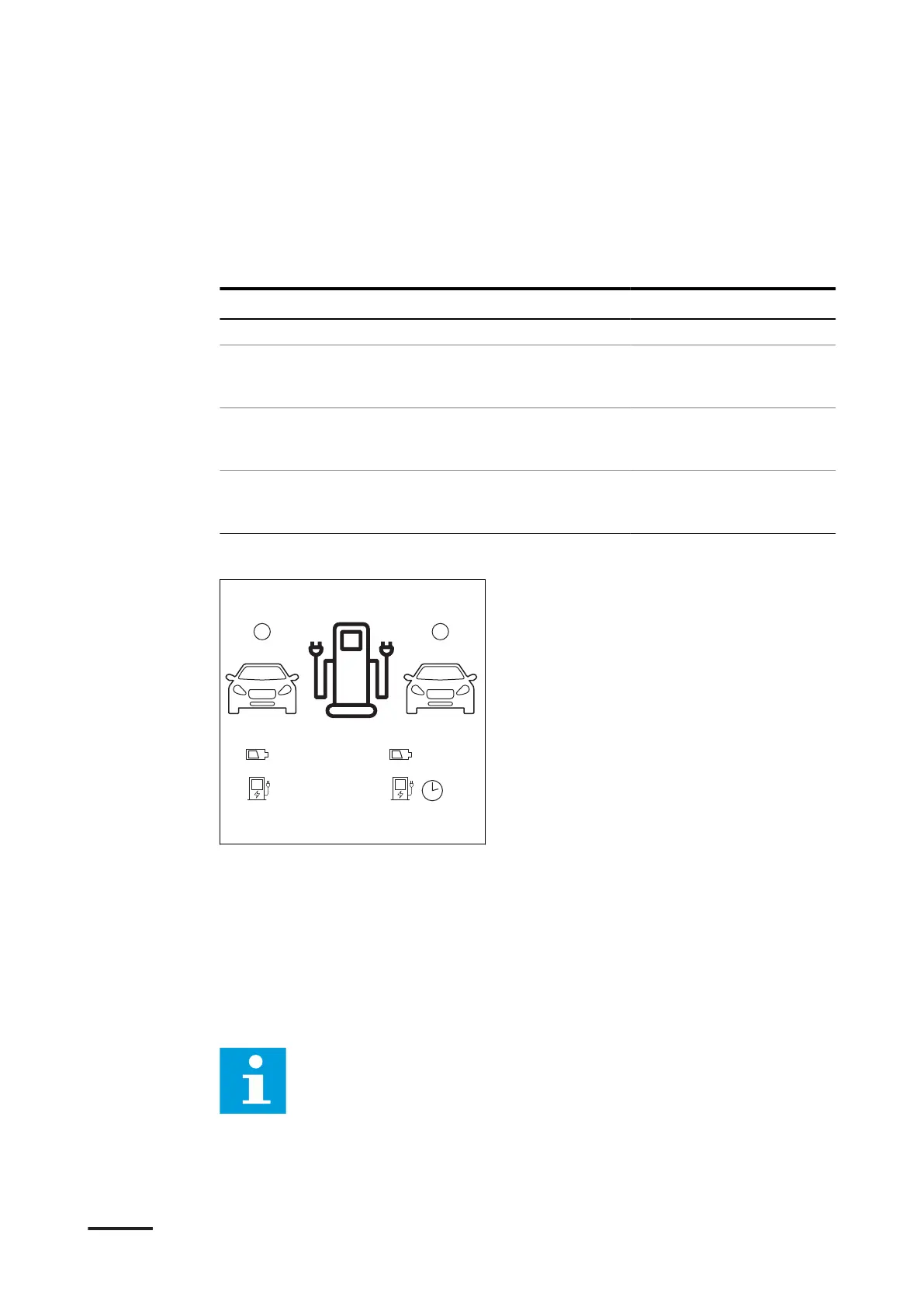
3.8.1 Sequential power allocation
When the EVSE is configured for sequential power allocation, it can serve one EV at
a time with DC fast charging.
In this configuration the EV charging power is the maximum power available to
the EVSE, the rated power output. Effectively the maximum power output can be
less than the rated power output because of power constraints. For example, the
power output can be permanently limited due to site current or power constraints,
or temporarily limited by power management systems.
Only one DC charge session can be performed at a time. When a second EV is
connected to the EVSE, the EVSE must first finalize the first charge session before a
new charge session can start.
Note:
EV charging with the use of the CCS standard can 'fall asleep' if the
EVSE does not start the session within a few minutes. This is a common
issue. It is recommended to connect a second EV only shortly before the
first charge session ends.
Description
32 9AKK108466A3703-EN | 001





 To Next Page