CHAPTER 4 REFERENCE GUIDE
EFD1000 PRO MAX PFD Pilot’s Guide
Page 4-3
091-00005-002 ()
4.1.1 Roll Scale
The Roll Scale is displayed at the top of the Attitude Indicator and comprises a moving
scale set against a fixed, white, triangle roll pointer. Tick marks are displayed at 0º, 10º,
20º, 30º, 45º, and 60º of roll. The 45º marks are triangles.
4.1.2 Pitch Scale
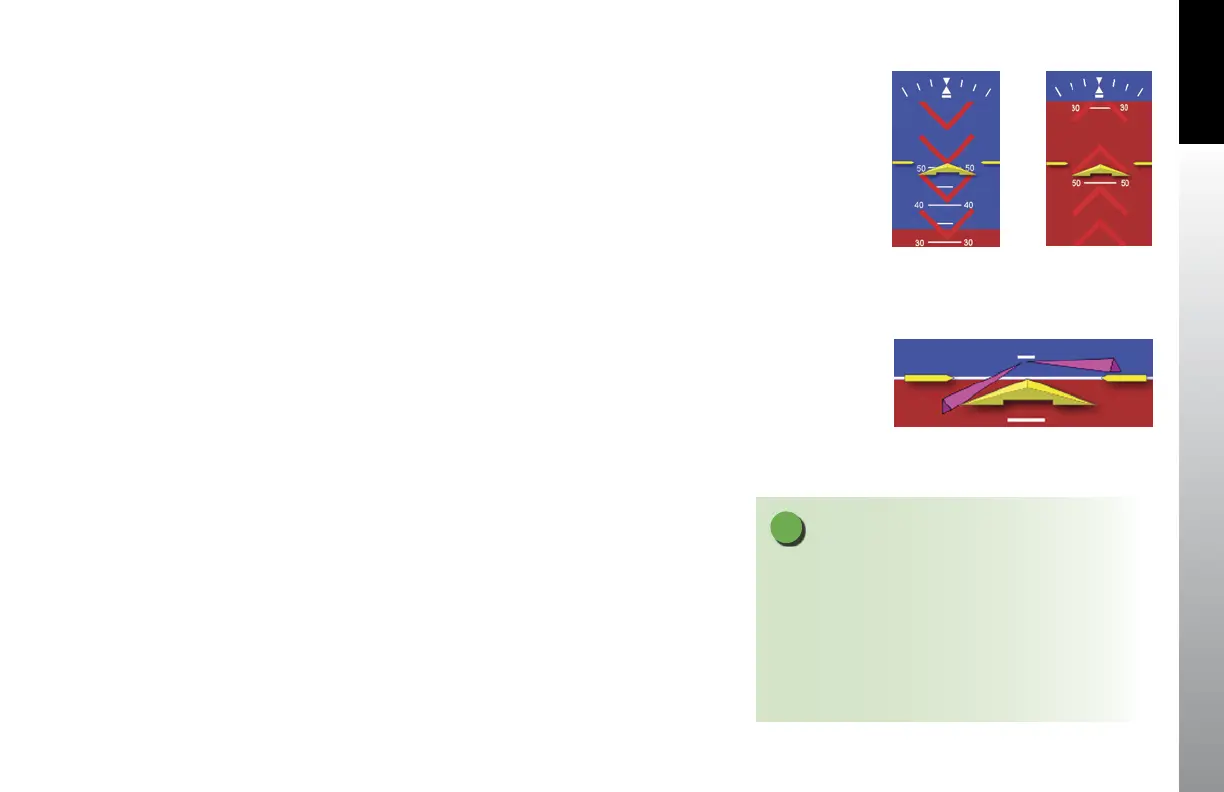
The pitch scale consists of minor pitch marks in 2.5º increments up to ±20º and major
pitch marks in 10º increments up to ±90º. Red chevrons come into view for nose-up
pitch angles of 15º or more (Figure 4-3), and nose-down pitch angles of 10º or less
(Figure 4-4). The pitch chevrons aid the pilot in unusual attitude recovery.
The range of movement of the background sky and ground boundaries are limited so
that some sky or ground is always visible.
4.1.3 Slip/Skid Indicator
The Slip/Skid Indicator is the small white rectangle under the roll pointer. The Slip/
Skid Indicator moves left and right relative to the roll pointer in proportion to lateral
acceleration. The width of the rectangle is equivalent to the width of the ball in a
mechanical inclinometer.
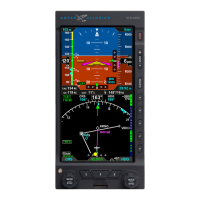
4.1.4 Flight Director
When connected to a compatible autopilot and configured through an ACU during
installation, the PFD displays a single-cue (two-axis) flight director on the Attitude
Indicator (Figure 4-5 ). The pilot may follow the flight director’s pitch and roll cues, even
when the autopilot is not engaged, to remain on heading or altitude, climb or descend,
turn, or navigate along a programmed flight path.
Figure 4-3
Pitch Markings
Large Pitch Down
Figure 4-4
Pitch Markings
Large Pitch Up
Figure 4-5
Flight Director
NOTE
Refer to the autopilot’s AFMS for information on the
operation of the flight director. The Flight Director
is a visual representation of the pitch and roll
commands from the autopilot. The Flight Director’s
pitch and bank limits are based on the emulation
mode set at installation and are limited to +/- 45°
roll and +/- 25° pitch.


 To Next Page