Ground Operations 3-9
In addition to the Engine tab, a datablock can be set to
continuously display engine information from any datablock-
format page-tab combination (e.g. Map+, Chart+, all FMS tabs, all
Checklist tabs, etc.) on the MFD.
Engine exceedances are constantly monitored regardless of
which pages and tabs are selected. If an exceedance occurs, the
Caution Warning system will present a Master Caution Alert in the
Primary Flight Display as well as an associated textual alert in the
bottom right corner of each IFD. There is more information on this
in later sections.
SETTING UP THE RADIOS AND TRANSPONDER
The keyboard is designed to be the primary location to perform all
Com radio tuning and Transponder code input. Assuming you
have entered your flight plan into the FMS, Nav tuning is
automatically done for you via the FMS. Alternatively, all tuning
can be done via the MFD but the system has been designed and
optimized for keyboard operations.
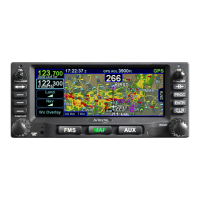
As a constant reminder of the frequencies loaded into the radios,
the top left and right corners of the MFD permanently display the
active and standby frequencies (Com 1 in the left corner, Com 2
in the right corner). Similarly, the left half of the Keyboard display
is reserved for permanent display of the active and standby
frequencies.
COM TUNING VIA THE KEYBOARD
The top edge of the keyboard has two rows of function keys. The
system will time out to the default “COM 1” function key within a
maximum of 10 seconds. For those aircraft equipped with the PS
Engineering PMA8000B or the Avidyne AMX240 audio select
panel, the keyboard will time out to the same "COM x" function
key as the active radio on the audio select panel. For example, if
COM2 is selected in the audio panel, the keyboard com tuning
button mirrors the timeout behavior. As long as one of the COM
function keys is active on the keyboard, typing a com frequency
via the alpha-numeric keys will populate the standby channel of
the selected radio with that value. Shortcuts are provided to aid
speed and ease of entering a frequency. For example, there is no
need to type the leading “1” for frequencies, the decimal point,
trailing zeros or the thousandths digit.



 To Next Page