LR2000 Programming Manual V1.2
[Notes] If the value of m is out of the specified range, nL and the data following are
processed as normal data.
The nL and nH indicate the number of dots in the bit image in the horizontal
direction. The number of dots is calculated by nL + nH 256.
If the bit-image data input exceeds the number of dots to be printed on a line, the
excess data is ignored.
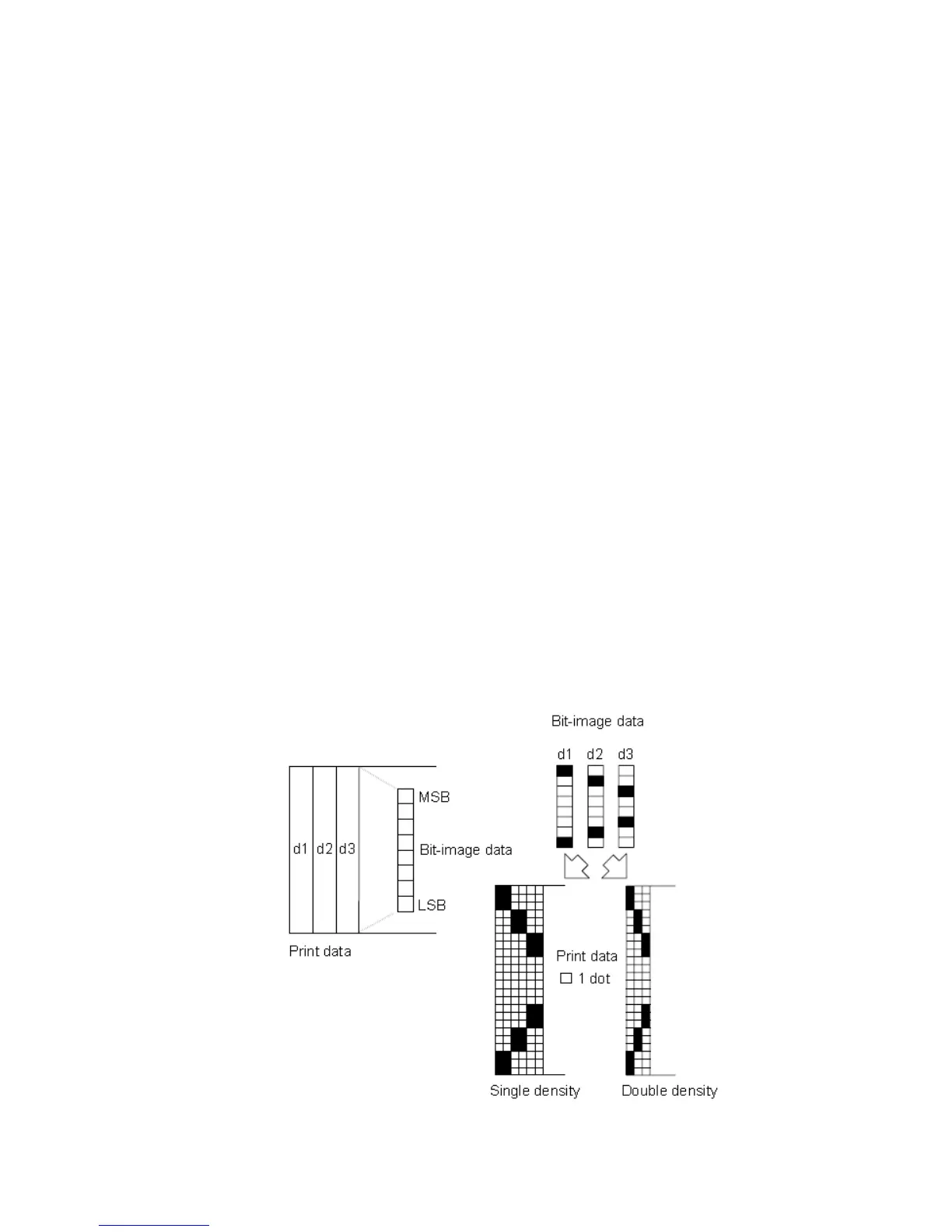
d indicates the bit-image data. Set a corresponding bit to 1 to print a dot or to 0 not
to print a dot.
If the width of the printing area set by GS L and GS W less than the width required
by the data sent with the ESC command, the following will be performed on the
line in question (but the printing cannot exceed the maximum printable area):
① The width of the printing area is extended to the right to accommodate the
amount of data.
② If step ① does not provide sufficient width for the data, the left margin is
reduced to accommodate the data.
For each bit of data in single-density mode (m = 0, 32), the printer prints two
dots: for each bit of data in double-density mode (m = 1, 33), the printer prints
one dot. This must be considered in calculating the amount of data that can be
printed in one line.
After printing a bit image, the printer returns to normal data processing mode.
This command is not affected by print modes (emphasized, double-strike,underline,
character size, or white/black reverse printing), except upside-down printing mode.
The relationship between the image data and the dots to be printed is described in
Figure 3.11.3.
When 8-dot bit image is selected:


 To Next Page