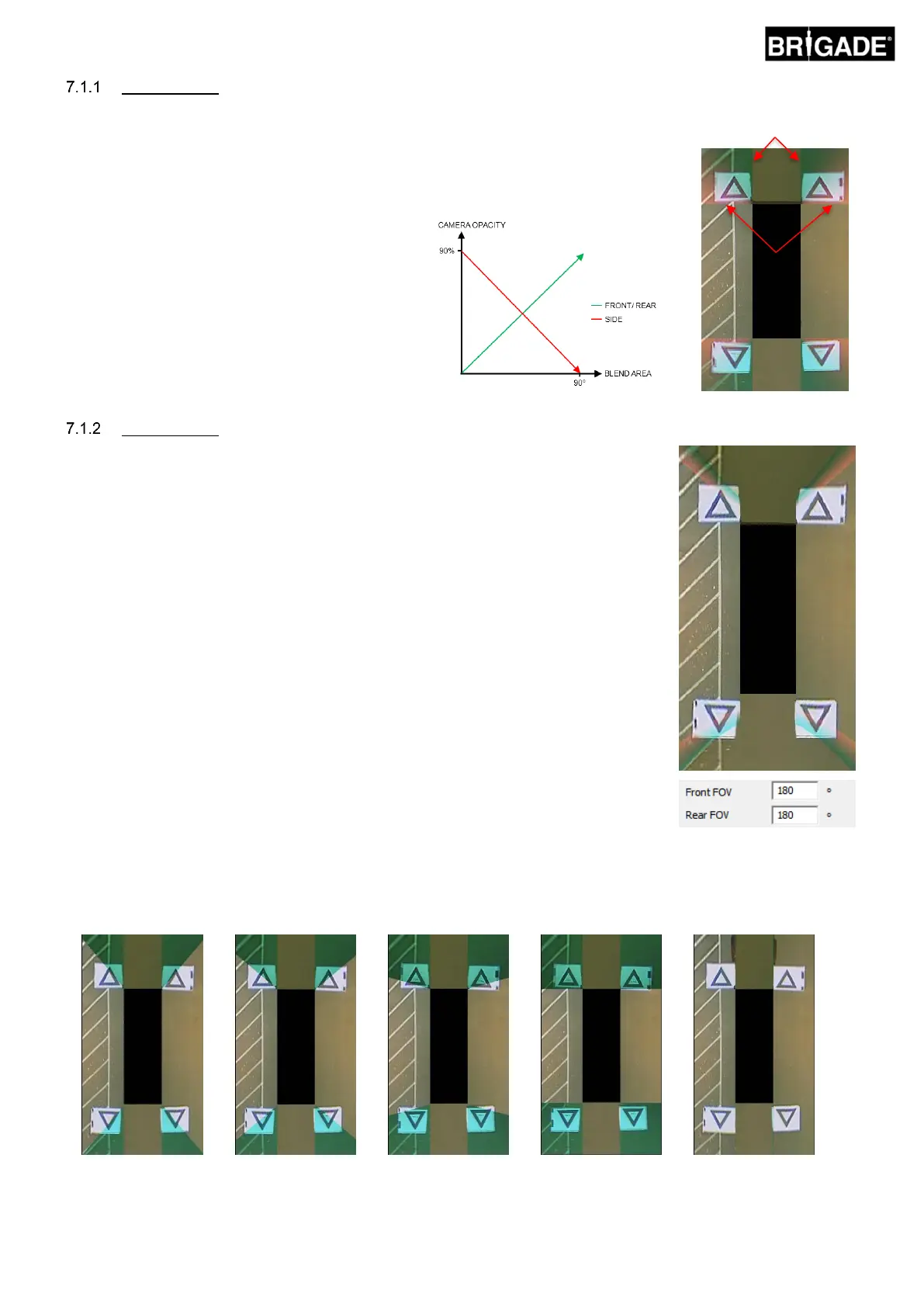
Blending Auto is Brigades recommended option as it gives the most ideal blend for most
typical installations, e.g. standard rectangular/box shaped vehicles.
A gradual blend is applied across the overlapping areas using 10% of the front/rear
camera image (shown in red) and 90% of the side camera image (shown in green) at the
edge of the vehicle mask.
The transparency of each camera is gradually
reduced/increased across the blend area to give a
smooth transition between each camera, the graph
shows how the camera images blend across the
Blend Area.
Blending FOV gives the user much more control of the blend, allowing the user to
choose where the blend starts and how hard or soft the blend is. This is especially useful
in cases where parts of the vehicle body obscure camera views e.g. overhanding side
mirrors etc.
The blend applied to this view differs from the Blending Auto option, in this instance
100% of the front/rear camera is used at the edge of the vehicle mask (where the FOV
starts).
When choosing this option the Front FOV, Rear FOV and Blending Width options can
be adjusted, these are detailed below.
Note: it may only be necessary to change the FOV setting for one of either the
Front or Rear cameras. For the area that the FOV is not to be adjusted Brigade
recommends setting the FOV for that camera to 140° and the Blend Width to 10°,
these values may need to be adjusted depending on the calibration but typically
give the closest match to the Blend Auto option.
Changing the Front and Rear FOV options adjusts the amount of the front and rear
camera that is used (i.e. the Field of View).
The images below show the effect of changing the FOV. The area in green indicates the portion of the surround
view image that is taken from the front/rear camera. As the FOV is increased, so does the amount of front/rear
camera image that is used to form the surround view image.
Note: The surround view image will always use the at least the width of the vehicle mask for the front/rear camera
image as shown in the images above. Even when the FOV is given as 0° the front camera image is still used to form
the surround view image because it is not possible for the side cameras to see beyond 180°.
90% front camera
10% side camera


 To Next Page