Operation Manual
FT1020G3 Rev 2.4
75
18 Commissioning an FT1020G3
18.1 General
No connection, other than the mains power supply should be made, prior to checking the
operation of the FDCIE.
Mains power should be turned on and charger voltage levels checked / set. If these levels
are correct, batteries can then be connected. Follow the procedures shown in section 18.2
below.
Basic operation of the FT1020G3 should be confirmed as supplied without any external
connections, ensure no earth fault shown on the LCD.
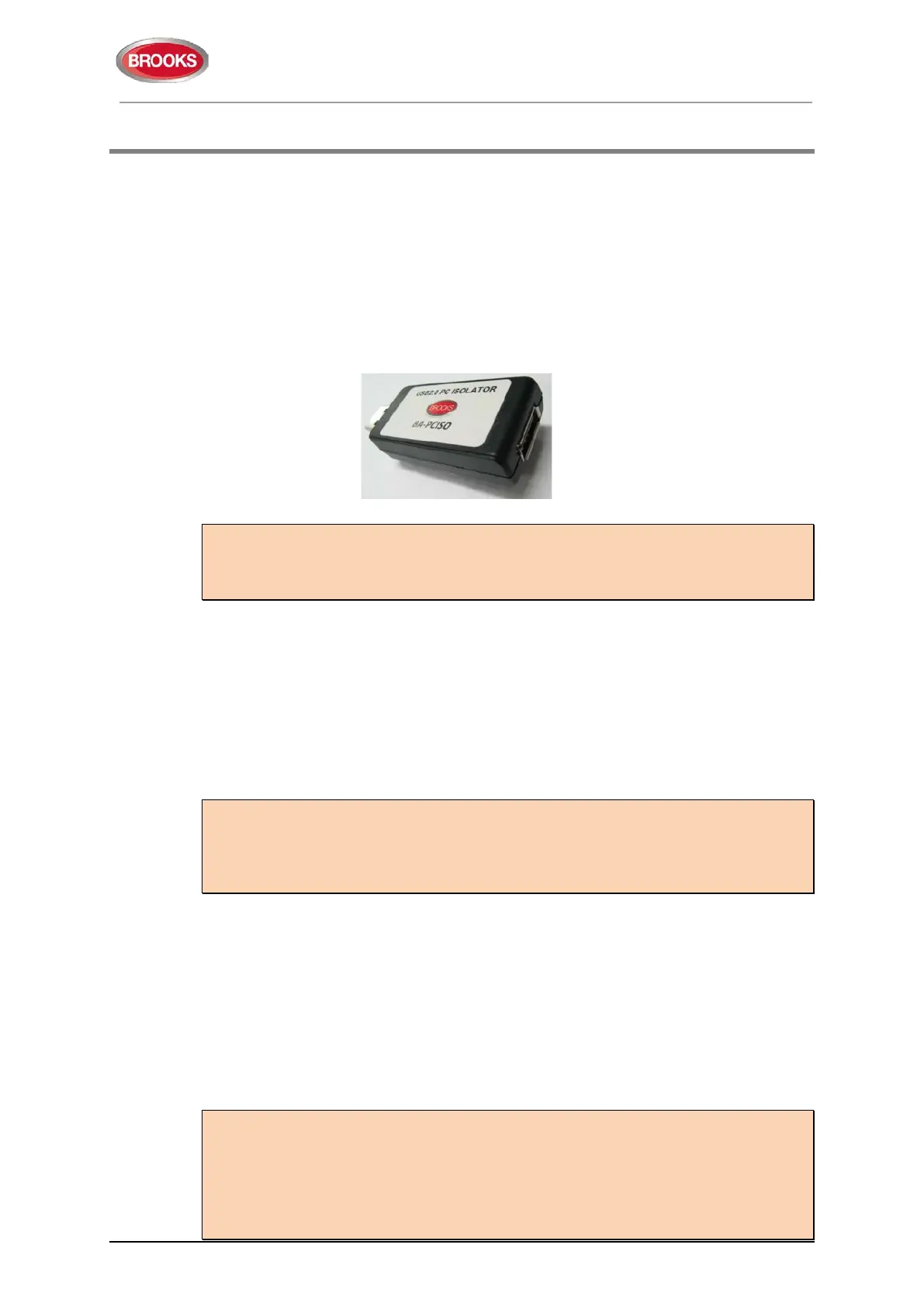
Note: To avoid generating earth fault when connecting a PC to FT1020G3, it is strongly
recommended to use Brooks USB isolator BA-PCISO. If no isolator is used and if
several earth faults exist in the system when a PC is connected, damages may result
on both PCBs (5010) and the PC.
The only “fault” seen by the system, which cannot be fixed at this point of time, should be
“Cut-off COM-loop x, CU xx”. This is due to some loop unites e.g. panel MCP, I/O matrix
boards, panel display modules etc. in FT1020G3 being wired to a COM loop as Class B
wiring (no loop return wiring used). In NZ control panels, the MCP mounted on the outer
door is normally replaced by the fire brigade Bulgin keys if required.
Before connecting any field wiring, the battery supply and mains power must be
turned off.
Cable resistance readings and field connections must then be checked to ensure they are
correct prior to their connection to the FDCIE.
Tip! Measure the resistance of each loop wire (L & C respectively) before turning on
the power. Check that the L-wire (SA) that goes out on terminal J5:1 comes back at
terminal J5:3 and so on. If the loop has short circuit isolators, only the C-wire (SB) can
be measured. Also measure the resistance between the loop wires and 24V, 0V and
Earth (J2:1, 2 and 3). The resistance should be very high (mega ohm).
18.2 Single Control Unit
Once the cabinet is mounted and secured in place, the following power up procedures
must be followed:
1. Connect the incoming mains power feed to the GPO, ensure the mains isolator
switch is “OFF”.
2. Terminate the COM loop and any field wiring into the plug-in connector but ensure
the plug-in connectors are not plugged in the main board 5010.
3. Turn “ON” the incoming mains power from the circuit breaker in the switch board.
Note: It should be connected to a household removable fuse for the fire alarm FDCIE
only, via a two-way circuit breaker.
The mains cable should be securely clamped and the wires be as short as possible, use
cable ties to keep mains wires well separated from 24VDC wires. The mains safety earth
(ground) should, however, be longer than the other wires, to ensure that it is the last to
be disconnected if the mains cable clamp should fail. After the installation, the lid
protecting the power supply screw terminals should be correctly applied.



 To Next Page