26 ChroMate™ Operator’s Manual Doc. 4300 Rev. E
Point to Point (Continued)
Description:
In the Linear Regression mode, resulting
concentrations will be the same no matter
what base is used (ln or log). However,
slopes and intercepts will vary. When using
a format which calculates the ln or log of the
concentration, (do not use 0.0 for the
concentration, since ln 0 and log 0 are not
defined. If a 0.0 concentration Calibrator is
used, it will be ignored when the regression
is calculated.) Note that in the logarithmic
modes, any values which require the log of
a zero or negative number are invalid, and
will either invalidate the curve (if in the
Calibrators) or invalidate the specimen.
Likewise, when using ln of 1000*Abs, the
absorbance values must be nonzero and
positive.
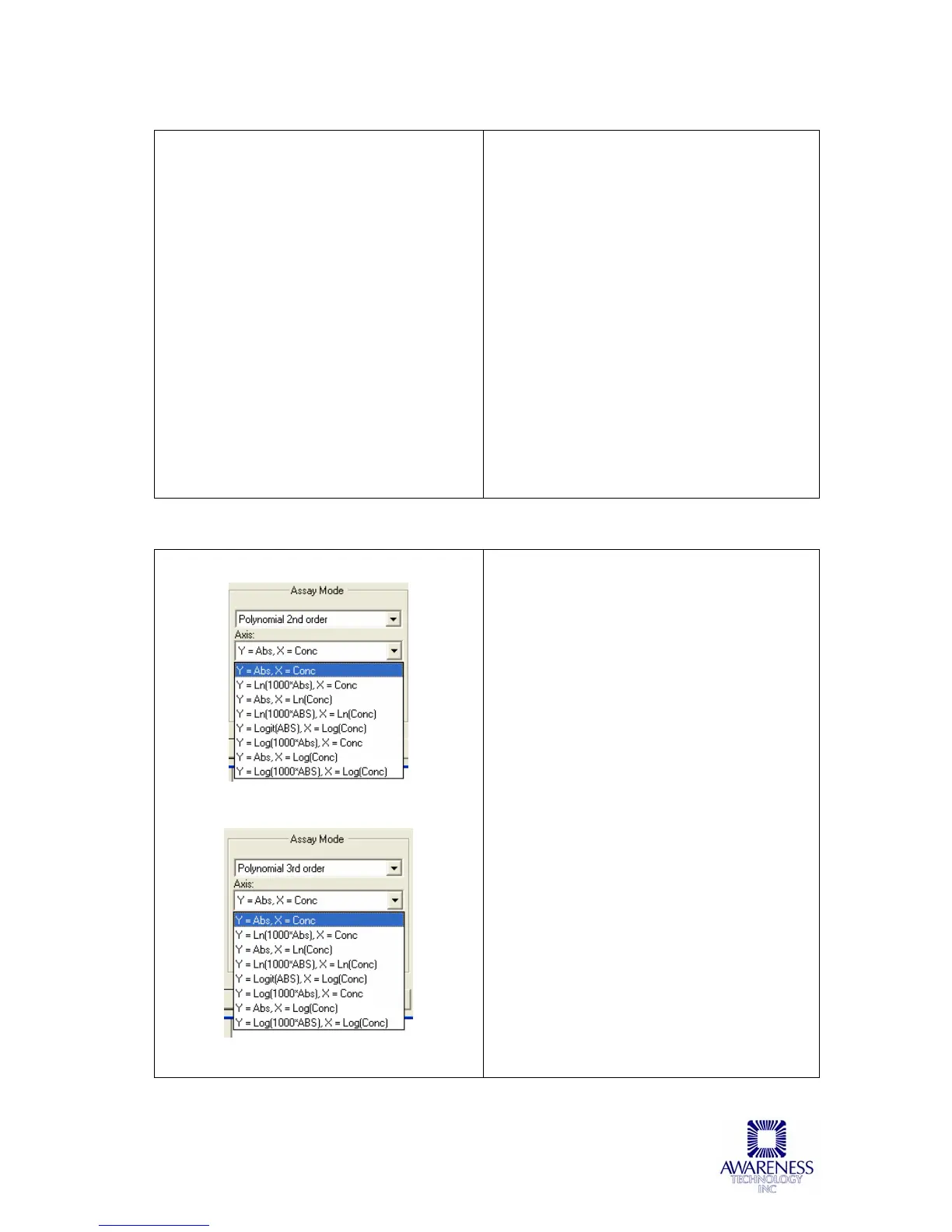
4.2.6 Polynomial Regression Mode
Polynomial Regression:
Description:
The instrument accepts a number of
calibrators (from 3 to 7), subsequently
calculating concentrations based upon the
best fit (polynomial regression) calibration
curve.
These modes use nonlinear regression to fit
the calibration curve to polynomial
equations. The order of the polynomial
equation tells you how many terms are in
the equation.
Higher order equations have more inflection
points.
Second order is defined by:
Y = A + B * X + C * X ^2
Third order is defined by:
Y = A + B * X + C * X^2 + D * X ^3
Forth order is defined by:
Y = A + B * X + C * X^2 + D * X ^3 + E * X ^4
Graphing and editing options are available.


 To Next Page