Some fuel refiners in several areas of the United
States have introduced a manganese additive (MMT)
for unleaded fuel. During combustion, fuel with MMT
may coat the entire tip of the spark plug with a rust
colored deposit. The rust color deposits can be misdi-
agnosed as being caused by coolant in the combustion
chamber. Spark plug performance is not affected by
MMT deposits.
COLD FOULING (CARBON FOULING)
Cold fouling is sometimes referred to as carbon
fouling. The deposits that cause cold fouling are basi-
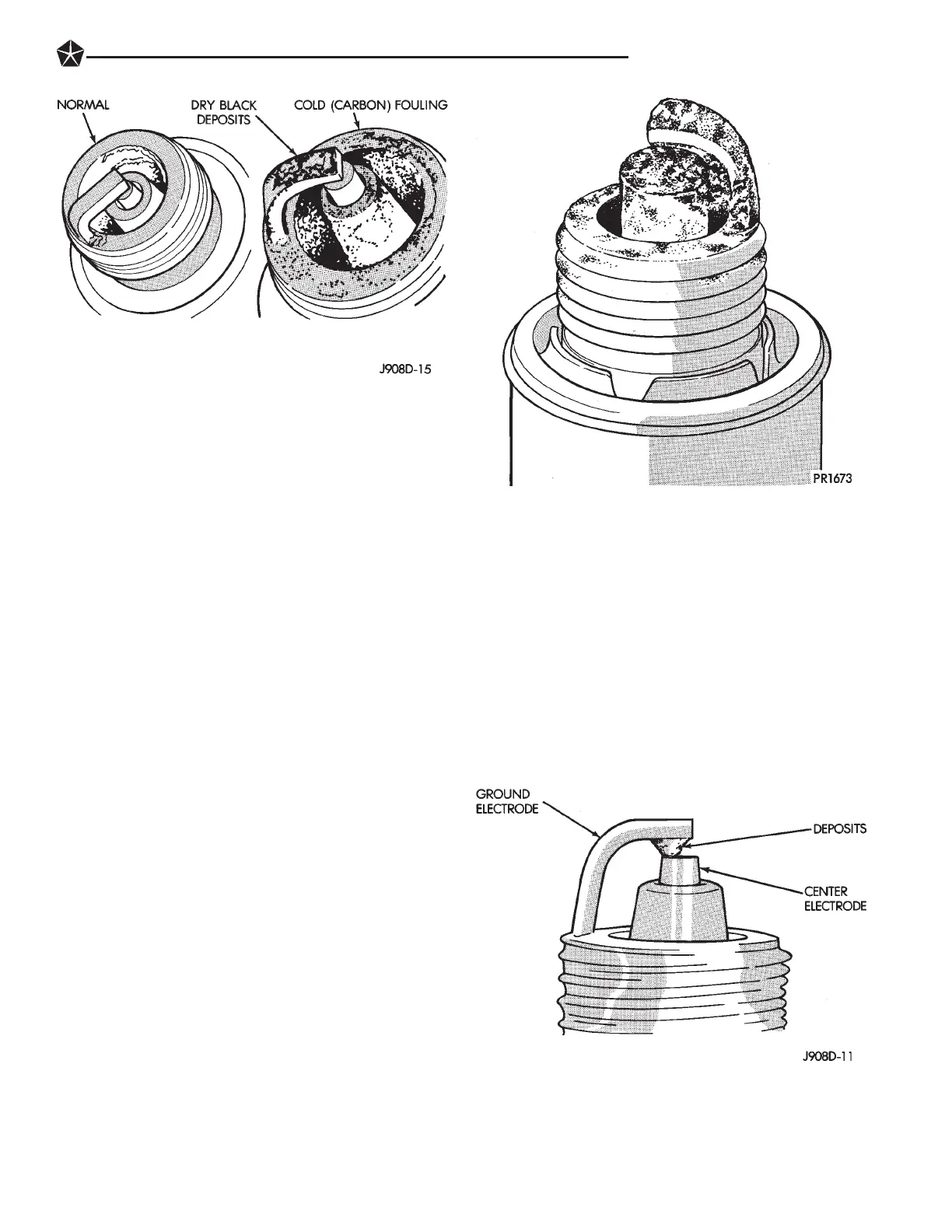
cally carbon (Fig. 4). A dry, black deposit on one or two
plugs in a set may be caused by sticking valves or
defective spark plug cables. Cold fouling of the entire
set may be caused by a clogged air cleaner.
Cold fouling is normal after short operating periods.
The spark plugs do not reach a high enough operating
temperature during short operating periods.
WET FOULING
A spark plug coated with excessive wet fuel or oil is
wet fouled. In older engines, worn piston rings or
excessive cylinder wear can cause wet fouling.
Break-in fouling may occur before new engines
achieve normal oil control. In new or recently
overhauled engines, wet fouled spark plugs can
usually be cleaned and reinstalled.
OIL OR ASH ENCRUSTED
If one or more plugs are oil or oil ash encrusted,
evaluate the engine for the cause of oil entry into the
combustion chamber (Fig. 5).
HIGH SPEED MISS
When replacing spark plugs because of a high speed
miss condition; avoid wide open throttle operation
for approximately 80 km (50 miles) after installa-
tion of new plugs. This will allow deposit
shifting in the combustion chamber to take place
gradually and avoid splash fouling shortly after the
plug change.
ELECTRODE GAP BRIDGING
Loose deposits in the combustion chamber can
cause electrode gap bridging. The deposits accumu-
late on the spark plugs during continuous stop-
and-go driving. When the engine is suddenly
subjected to a high torque load, the deposits partially
liquefy, bridge the gap, and short circuit the elec-
trodes (Fig. 6). Use standard procedures to clean
spark plugs with electrode gap bridging.
SCAVENGER DEPOSITS
Fuel scavenger deposits may appear either white or
yellow (Fig. 7). They may look harmful, but are a
Fig. 5 Oil or Ash Encrusted
Fig. 6 Electrode Gap Bridging
Fig. 4 Normal Operation and Cold (Carbon) Fouling
IGNITION SYSTEMS 8D - 3










 To Next Page