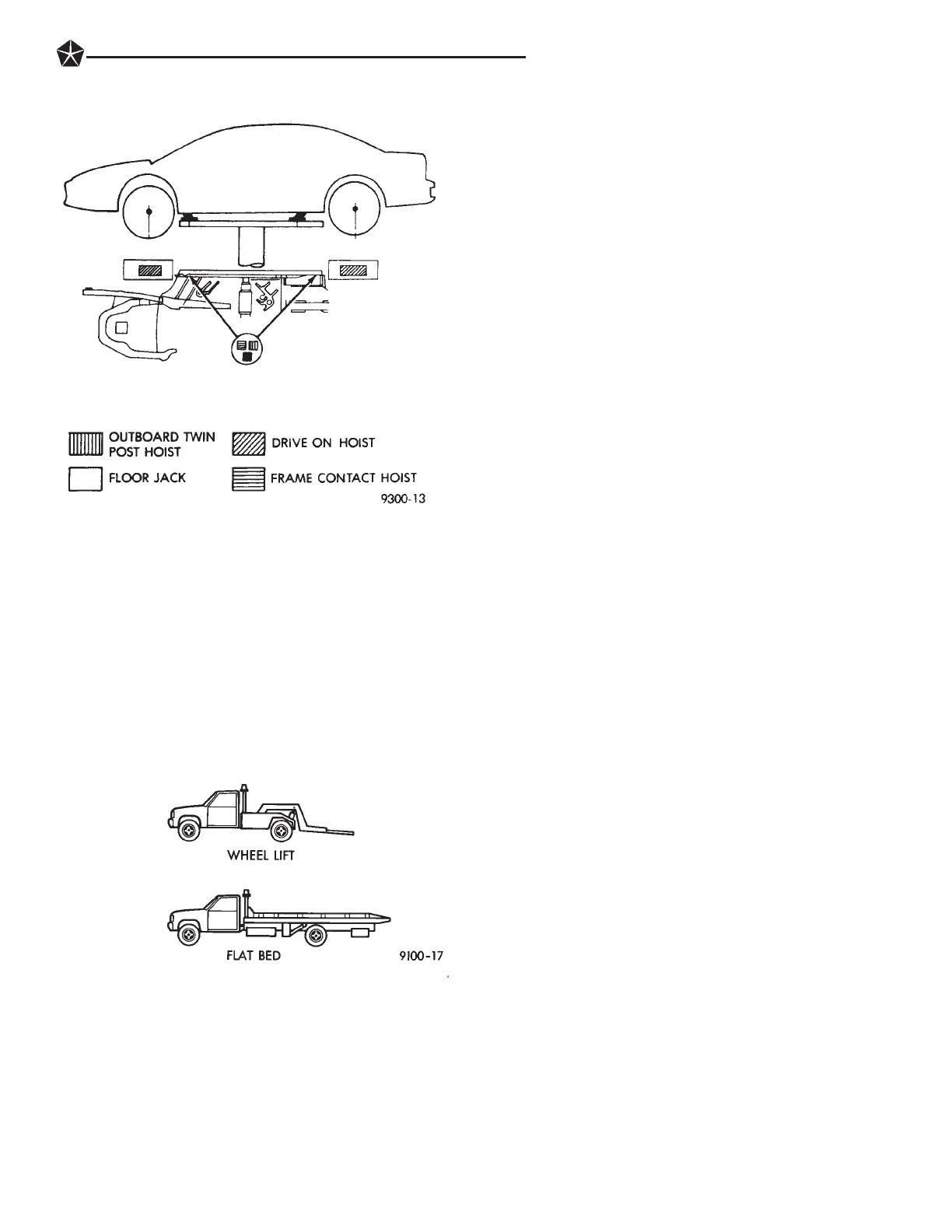
TO HOIST OR JACK VEHICLE SEE FIG. 2
TOWING RECOMMENDATIONS
RECOMMENDED TOWING EQUIPMENT
To avoid damage to bumper fascia and air dams
use of a wheel lift or flat bed towing device (Fig. 3) is
recommended. When using a wheel lift towing de-
vice, be sure the rear end of disabled vehicle has at
least 100 mm (4 in.) ground clearance. If minimum
ground clearance cannot be reached, use a towing
dolly. If a flat bed device is used, the approach angle
should not exceed 15 degrees.
GROUND CLEARANCE
CAUTION: If vehicle is towed with wheels removed,
install lug nuts to retain brake drums or rotors.
A towed vehicle should be raised until lifted wheels
are a minimum 100 mm (4 in) from the ground. Be
sure there is adequate ground clearance at the oppo-
site end of the vehicle, especially when towing over
rough terrain or steep rises in the road. If necessary,
remove the wheels from the lifted end of the vehicle
and lower the vehicle closer to the ground, to in-
crease the ground clearance at the opposite end of
the vehicle. Install lug nuts on wheel attaching studs
to retain braking discs.
SAFETY PRECAUTIONS
The following safety precautions must be consid-
ered when preparing for and during a vehicle towing
operation:
• Do NOT tow vehicle with front wheels on the
ground. The transaxle can be damaged.
• Secure loose and protruding parts from a disabled
vehicle.
• Always use a safety chain system that is indepen-
dent of the lifting and towing equipment.
• Do not allow any of the towing equipment to con-
tact the fuel tank of the vehicle being towed.
• Do not go under the vehicle while it is lifted by
the towing equipment.
• Do not allow passengers to ride in a vehicle being
towed.
• Always observe all state and local laws pertaining
to warning signals, night illumination,speed, etc.
• Do not attempt a towing operation that could jeop-
ardize the operator, bystanders or other motorists.
• Do not exceed a towing speed of 48 km/h (30mph).
• Avoid towing distances of more than 24 km
(15miles), whenever possible.
• Never attach tow chains or a tow sling to the
bumper, steering linkage, or constant velocity joints.
TIE DOWN LOCATIONS FOR FLAT BED
TOWING
There are three reinforced elongated holes on each
side of the vehicle designed to serve as hold down lo-
cations. These locations can safely hold the vehicle to
the towing device using T or R-hooks.
• Bottom of the front frame rail forward of the en-
gine cradle.
• Bottom of the forward torque box between the
front frame rail and the rocker panel.
• Bottom of the rearward torque box forward of the
rear wheel.
FRONT TOWING PROCEDURES
CAUTION: Do Not tow vehicle from the front with
sling type towing device. Damage to bumper fascia
will result.
Always tow vehicle with front wheels off the
ground as shown (Fig. 4).
Use a flat bed towing device when wheel lift tow-
ing device is not available.
Fig. 2 Hoisting and Jacking Points
Fig. 3 Recommended Towing Devices
LUBRICATION AND MAINTENANCE 0 - 5








 To Next Page