6Mechanical Installation Installation & Commissioning Manual
24
5100607_CFD5000 T - CM2.2_Installation & Commissioning Manual_T_EN_2023_F
•
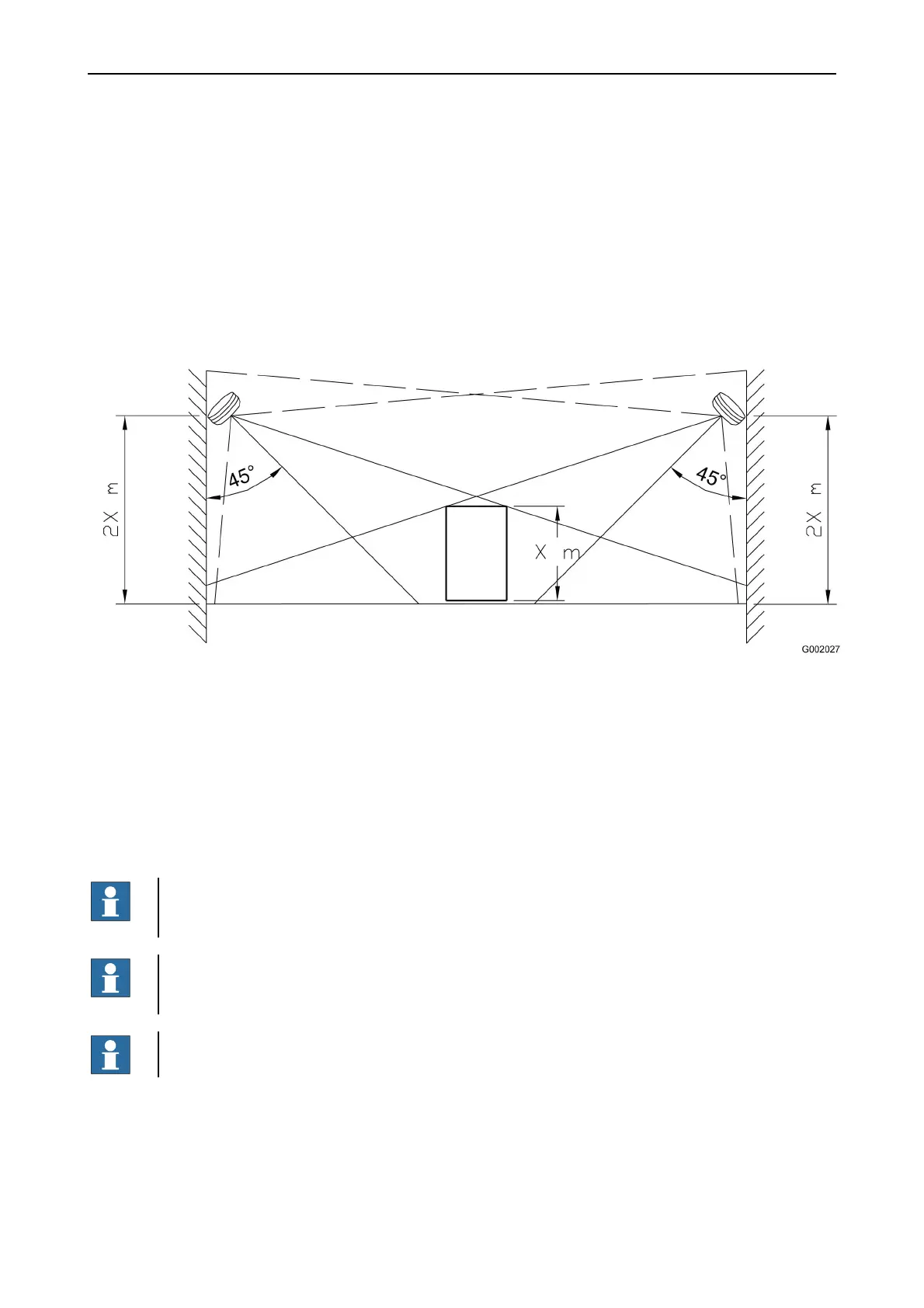
Avoid shadow areas from objects in the room, by placing a second flame
detector facing the opposite side of the object, see Figure12. An example of
flame detector mounting.
•
Mount the flame detector to give it clear access to the location of the
anticipated fire. See data sheet of flame detector for more information about
cone of vision. Place the detector beside, but not directly above, the protected
object to prevent the risk that black smoke may block the flames. Place the
detector at an angle of 45° downwards. This way the detector will project both
downward and forward and catch the least amount of dirt. For more
information about its angle of projection, refer to the flame detector’s data
sheet.
Figure 12. An example of flame detector mounting
•
A general rule is to install the detector on a height that is twice the height of
the highest object in the supervised area, if possible.
•
Avoid sources for false alarm (e.g. flares) from entering the detector’s cone of
vision.
6.4.7 Installations in hazardous (Ex-classified)
location/area
NOTE!
When used in a hazardous area the loop units must be connected to a CS-Isolator.
Refer to the 5210050-00A CS-Isolator data sheet for connection examples.
NOTE!
In hazardous areas it is highly recommended to connect as loops and not as
branches/spurs.
NOTE!
Ex loop units are not allowed on redundant loops.
6.4.7.1 Intrinsically Safe Detector for Hazardous Areas
•
Select the detector’s location as described under section Smoke detectors, page
22 respectively section Heat detectors, page 23.



 To Next Page