Emergencies
rotating in only one direction. An arrow on
the tyre sidewall indicates the direction of ro-
tation on tyres with directional tread. Always
observe the indicated direction of rotation in
order to guarantee optimum grip and help
avoid aquaplaning, excessive noise and
wear.
If the tyre is mounted in the opposite direc-
tion of rotation, drive with extreme caution,
as the tyre is no longer being used correctly.
This is of particular importance when the
road surface is wet. Change the tyre as soon
as possible or remount it with the correct di-
rection of rotation.
Works after changing a wheel
●
Replace the wheel bolt caps.
●
Return all tools to their proper storing loca-
tion.
●
If the replaced wheel does not fit in the
spare wheel housing, store it safely in the
luggage compartment
›››
page 131 .
●
Check the tyre pressure of the newly
mounted tyre as soon as possible.
●
In vehicles fitted with a tyre pressure indi-
cator, adjust the pressure and store it in
memory
›››
page 308 .
●
Have the tightening torque of the wheel
nuts checked as soon as possible with a tor-
que wrench
›››
page 47 . Meanwhile, drive
carefully.
●
Have the flat tyre replaced as quickly as
possible.
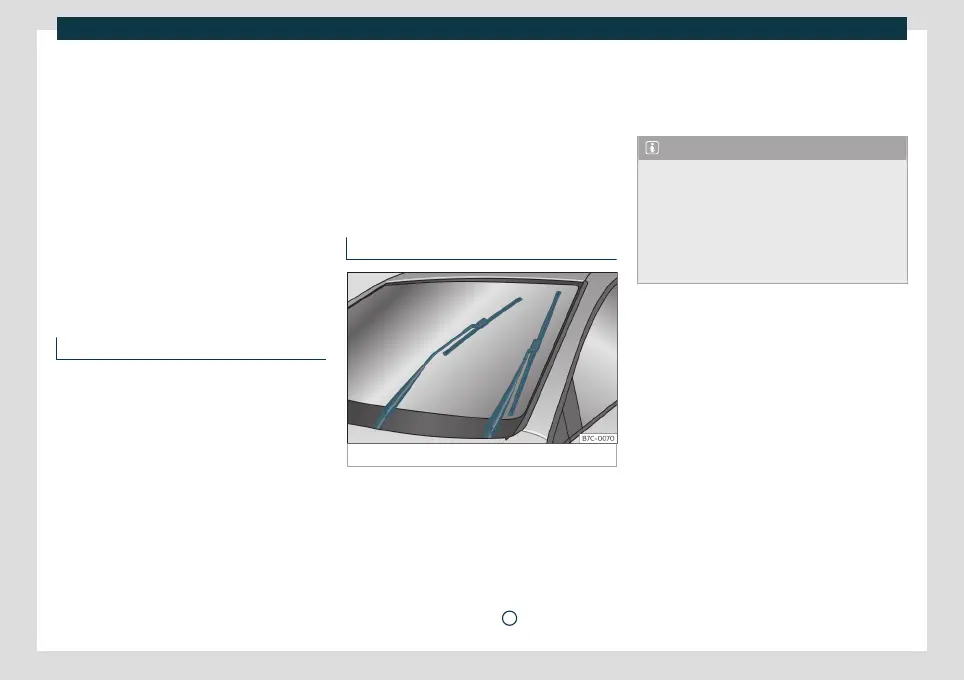
Changing the windscreen wiper
blades
Wiper service position
Fig. 37
Wipers in service position.
Ensure that the wiper blades are not frozen.
The wiper arms can be raised when the wip-
ers are in service position
›››
Fig. 37 .
●
Close the bonnet
›››
page 287 .
●
Switch the ignition on and off.
●
Press the windscreen wiper lever down-
wards briefly
›››
page 120
4
.
Before driving, always lower the wiper arms.
Using the windscreen wiper lever, the wind-
screen wiper arms return to their initial posi-
tion.
Note
●
The windscreen wiper arms can be
moved to the service position only when
the bonnet is properly closed.
●
You can also use the service position, for
example, if you want to fix a cover over the
windscreen in the winter to keep it clear of
ice.
48



 To Next Page