Design and function
42 © Festo Didactic Conveyor
Set up:
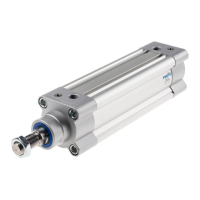
In the internal thread of the cylinder piston rod, a hexagon socket screw with washer is introduced. The
washer forms a positive fit with the brass element as long as the brass element is not pressed down by hand
and the cylinder is in the home position. Between brass element and cylinder body a spring is inserted.
The cylinder is connected via two connections, each with a one way flow control valve. The one way flow
control valves are connected to the monostable 5/2-way valve.
The use of the spring-return cylinder as a double-acting cylinder with a monostable 5/2-way valve is due to
the following requirements for the stopper:
Stopper requirements:
In the basic position the piston rod of the cylinder should extend.
The speed for retracting and retracting the cylinder should be adjustable separately.
Excessive noise during the extension and retraction movement of the cylinder should be avoided.
In the event of compressed air or voltage drop, the cylinder must assume its basic position, ie extend.
Compressed air and / or voltage must not lead to any hazard exposure.
The extension of the cylinder must not exert excessive impact on an overlying carrier.
The cylinder should be dimensioned as small as possible.
Analysis of the movement profile:
Situation:
In the depressurized state, the piston rod is in the upper end position due to the spring return, as it is a
compact cylinder of the AEVUZ (pulling mode) series. Also, the brass element is in the upper end position,
since due to the extended cylinder piston rod, the spring between brass element and cylinder body is
relaxed.
Both the brass element, as well as the piston rod can be pressed down in the pressureless state. Brass
element and piston rod then return to their normal position.
Compressed air connection / resistance:
As soon as the compressed air is switched on, the piston rod can no longer be pushed down by hand.
However, the brass element already, since its position in the basic position of the cylinder depends only on
the state of the spring between the brass element and the cylinder body.
The behavior with compressed air connection / resistance is comparable to the upward movement:
Upward movement:
The 5/2-way valve ventilates in the basic position, the lower chamber of the cylinder. The rising pressure in
the lower chamber and the spring installed in the cylinder press the piston rod out of the cylinder housing
until the upper end position is reached. In this case, the one way control valve -RZ2 allows the compressed
air without throttling. The compressed air from the upper chamber escapes via the one way control valve -
RZ1. This is therefore an exhaust air throttling. This allows the speed of the upward movement to be
adjusted.
If no carrier is located above the stopper, the brass element also returns to its basic position. The upward
movement of the piston rod relaxes the spring between the brass element and the cylindrical body during
the movement. This also pushes the brass element upwards.


 To Next Page