Generator Faults
22.3.11 Panda PMS 8.000 NE - 42 NE Manual.R05 - Kapitel/Chapter 7: Generator Faults Seite/Page 159
7.7.4 Consequences of a continual overloading of the Actuator
If the generator is overloaded, the voltage falls under the nominal value due to insufficient engine power. The actua-
tor is already at the upperst speed limit and still tries to rise the rev. speed of the engine. There is an internal control
which limits the actuator current, but an overloading over a longer period of time can still damage the winding of the
actuator.
This will not effect the operation ability of the engine, but it can happen that the cranking torque of the actuator is get-
ting weak. This has the consequence that the rev. spindle can not be turned to all positions correctly. Therefore the
voltage regulatiron of the generator is very bad or the generator is temporarily not beeing regulated at all.
If you should notice that the actuator for the spindle sometimes does not run smoothly, then a check must be made
to determine whether the generator has been effectively overloaded for periods, therefore causing damage to the
internal winding of the actuator. The actuator must then be exchanged.
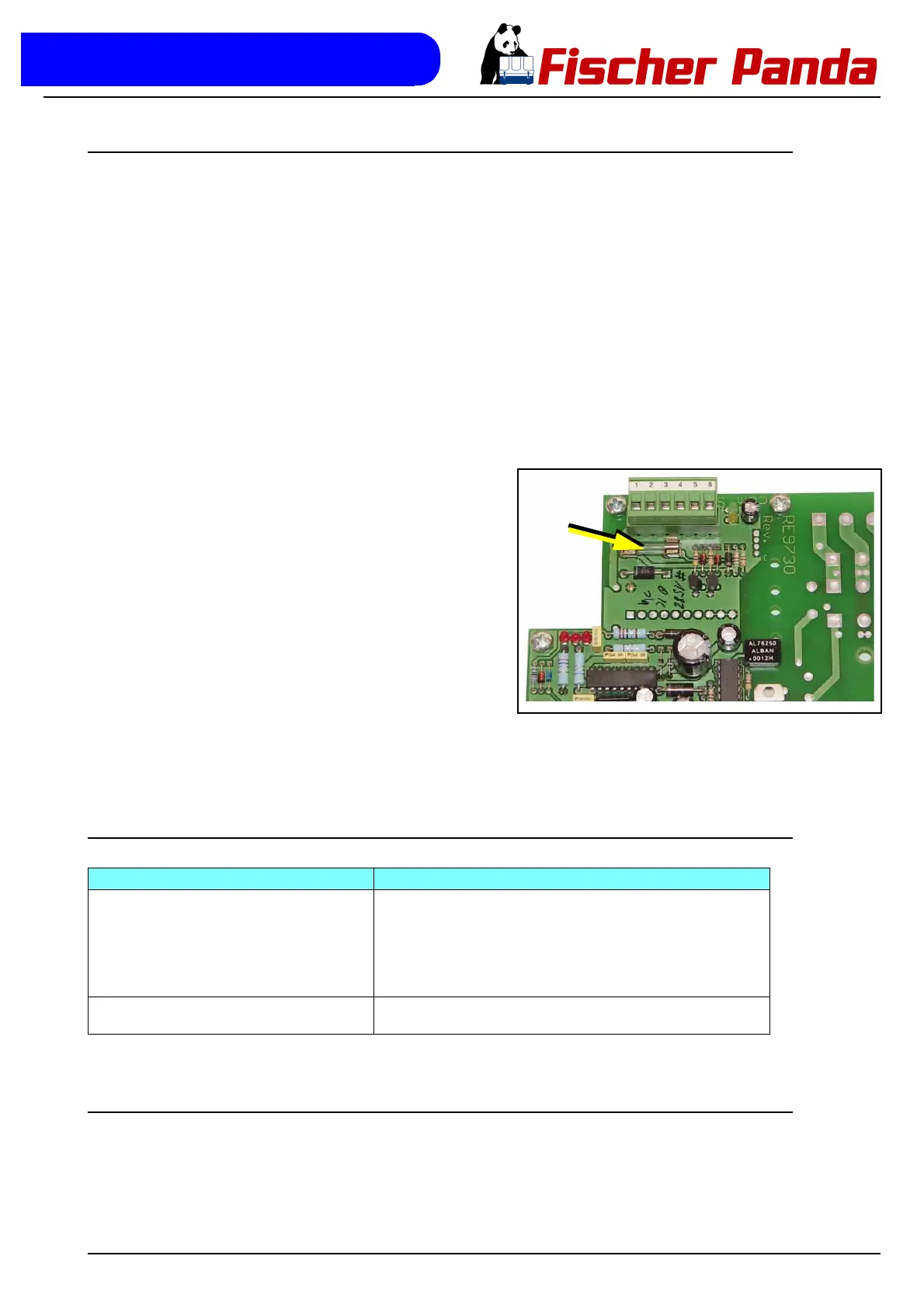
The electrical fuses on the circuit board must be checked, if the actuator for controlling the speed does not
turn.
Fig. 7.7.4-1: Fuse for the actuator at the remote control panel
Change fuse for the actuator at the remote control panel here
Note: The Mini VCS has no internal fuse
Change this fuse at standard VCS
(1,6 A slow to blow)
True, overloading cannot damage the actual generator, since the windings are safe from overloading and short cir-
cuiting, but damage is always possible to peripheral consumers. This is especially the case for connected consu-
mers, which can easily be damaged because of current that is too low.
7.7.5 Possible faults concerning the speed control „VCS“
1.
7.7.6 Steps to check the voltage control in case of a failure:
1. Switch the load off .
2. Remove plug from the actuator.
3. Turn the actuator by hand to determine whether the adjusting nut has jammed against the speed governor.
4. Turn the actuator by hand to check whether the adjusting nut runs smoothly on the spindle.
Problem Possible Cause
The spindle of the actuator jams Not regularly lubricated.
Surface has mechanical damage.
Actuator is defective (evtl. winding short cut).
Defect of the VCS control.
Signal 230 V (115 V) AC missing.
Limiting nut jams the spindle.
Fuse on the printed circuit board of the VCS control
is melted.
Constant overload of the generator.



 To Next Page