FLAMIC S.R.L. 5 Via dell’Artigianato, 36035 Marano Vicentino (Vicenza) - Italy
56
Dough sheeter SF450 - SF500 - SF600 Operation and maintenance manual (translation of original instructions) – Ed. 10/2016
Rev.02 10/2017
All rights reserved. Reproduction in whole or in part of this manual is prohibited.
2. Fixed guards: These are guards that are secured by fastening devices which can only be removed by using
tools. If properly installed and fixed to the support structure, they make it impossible to access, in particular
(but not only), the drive mechanisms of the dough thicknessing rollers and the conveyor belt drive rollers.
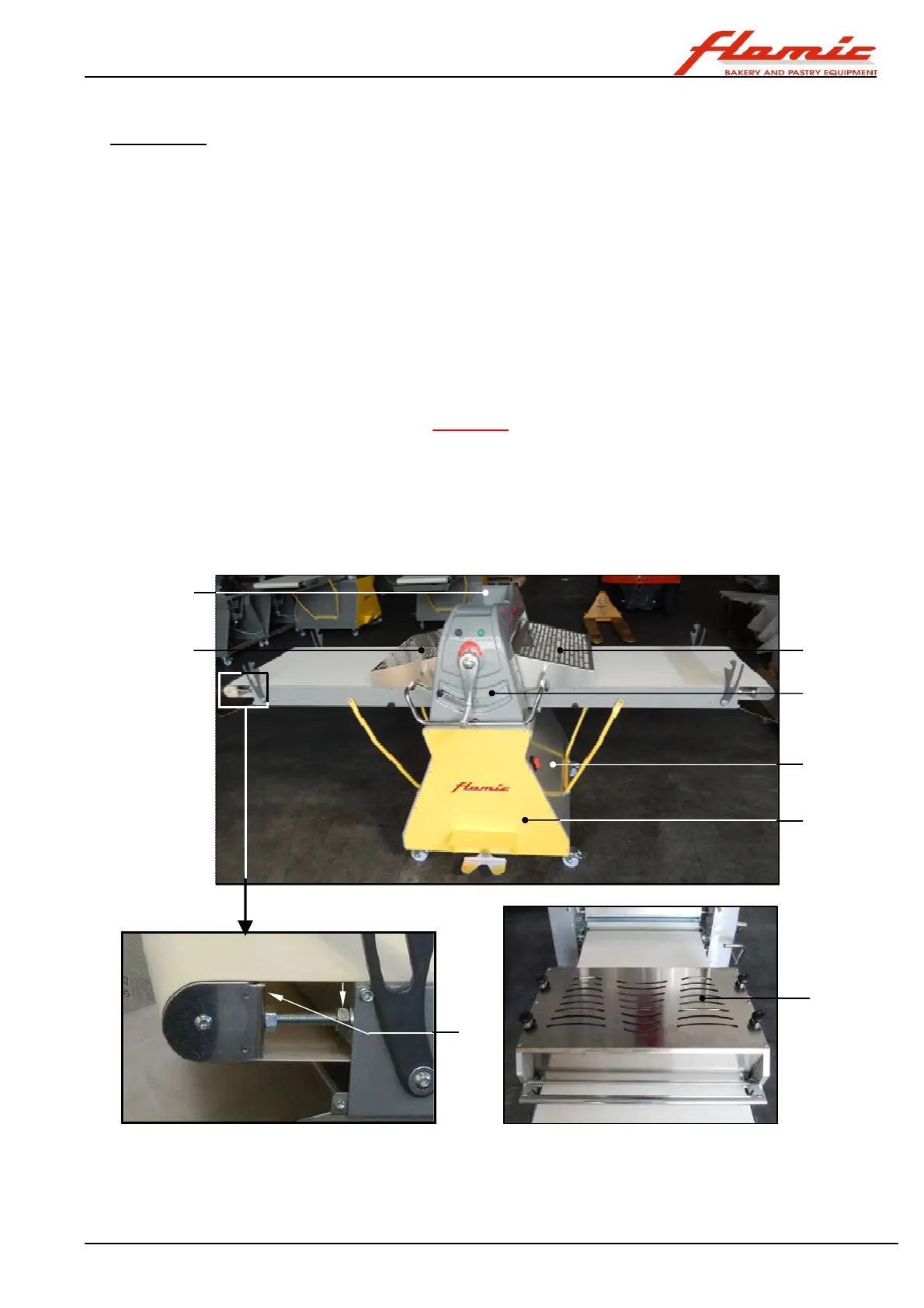
The main fixed guards of the machine are those indicated in ref. 1, ref. 2 (analogous guards are located in a
similar position on the opposite side of the machine) and those in ref. 3 Figure 47.
The C profiles ref. 7 Figure 47 that cover the whole length of the conveyor belt rollers (only those at the outer
ends of the tables) are also considered to be fixed guards as well as any plates ref. 4 Figure 32. Their
maximum distance from the conveyor belt and the roller, must not be greater than 4 mm.
The base ref. 4 also prevents access to the transmission components and the uprights and guards ref. 5 act
as fixed guards to prevent access to the thicknessing rollers from the sides and from above.
Note also the importance of the cover ref. 6 of the cutting unit. Even if it is not actually a fixed guard (it
doesn’t need tools to remove it), it is as if it were because when the unit is locked in its working position and
the working parts are moving, it is impossible to access them (in this condition the gap through which the
sheet of dough passes is such as to prevent the hazardous components from being reached). As soon as
the unit is released and raised, the rollers stop due to the lack of friction required to make them move.
WARNING!
Do not remove the guards and/or disable safety devices, unless it absolutely necessary to do so and after
having adopted all possible measures to minimize the associated risks and only and exclusively with
authorization of the employer, manager, person responsible etc.
Replace the guards and secure them with all the fastenings provided andre-enable the safety devices as
soon as there is no longer any reason for them to be removed/disabled.
Anyone who does not comply with the above will be held liable for any damage or injury, direct or indirect that
may be caused to persons, animals or property.
Figure 47 - Guards fastened with screws or similar means
6
3
5
4
5
2
1
7



 To Next Page