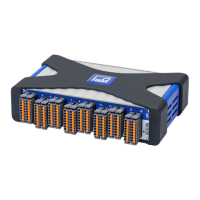
Starting up the ClipX
ClipX
a4643-1.0 HBM: public 57
7 Starting up the ClipX
The first section of this chapter explains the general power-up and operating
behavior of the ClipX following a successful installation. Then the steps required
to put the ClipX into operation are explained. For initial start-up, you should con-
nect the ClipX via Ethernet to a PC. The description of operation via one of the
fieldbuses can be found in chapter Operation via fieldbus
.
7.1 Power-up and operating behavior
When the ClipX is powered up, all the inputs and output remain at 0 or 0.0V as
appropriate. The start parameter set is loaded and activated first (= initializa-
tion). As soon as the ClipX has initialized, the outputs are set to the preset or
calculated values (factory setting for the digital outputs: 0, not inverted). If the
analog output is inactive, the output has a high internal resistance. If the source
signal for the analog output is invalid, the specified value in case of an invalid
signal is outputted (factory setting 11V but disabled).
The digital inputs and outputs and the calculations are updated at the sampling
rate (1000Hz). The signal at the analog output is updated at 19.2kHz. If the
source signal has a smaller rate of change, the value is outputted multiple times.
Values are transferred from synchronized ClipX devices at a maximum of 1000
values per second, so with six connected device you get 6000 values per
second. The maximum time delay between the ClipX values transmitted over
the ClipX bus is 1ms.
If you want to operate multiple ClipX devices, you should first connect
each ClipX device individually to a PC and perform a basic configu-
ration (e.g. IP address and Name).
Then read the section headed
Synchronizing multiple ClipX CF am-
plifiers so as to avoid interference between the devices.
Up to three clients (PCs) can connect to a ClipX; any further connec-
tion is then rejected.


 To Next Page