You can use the above tables for rise time error to approximate the error in
pulse width measurements by substituting "pulse width" for "rise time." If a
pulse has Gaussian shape and its width is greater than 3X the oscilloscope’s
rise time, the error in the measured pulse width will be less than 5 percent,
and the error in peak height measurements will also be less than 5 percent.
You can extend this concept to channel-to-channel time-interval
measurements between edges of opposite polarity. Measuring the time
interval between two closely spaced edges of opposite polarity on two
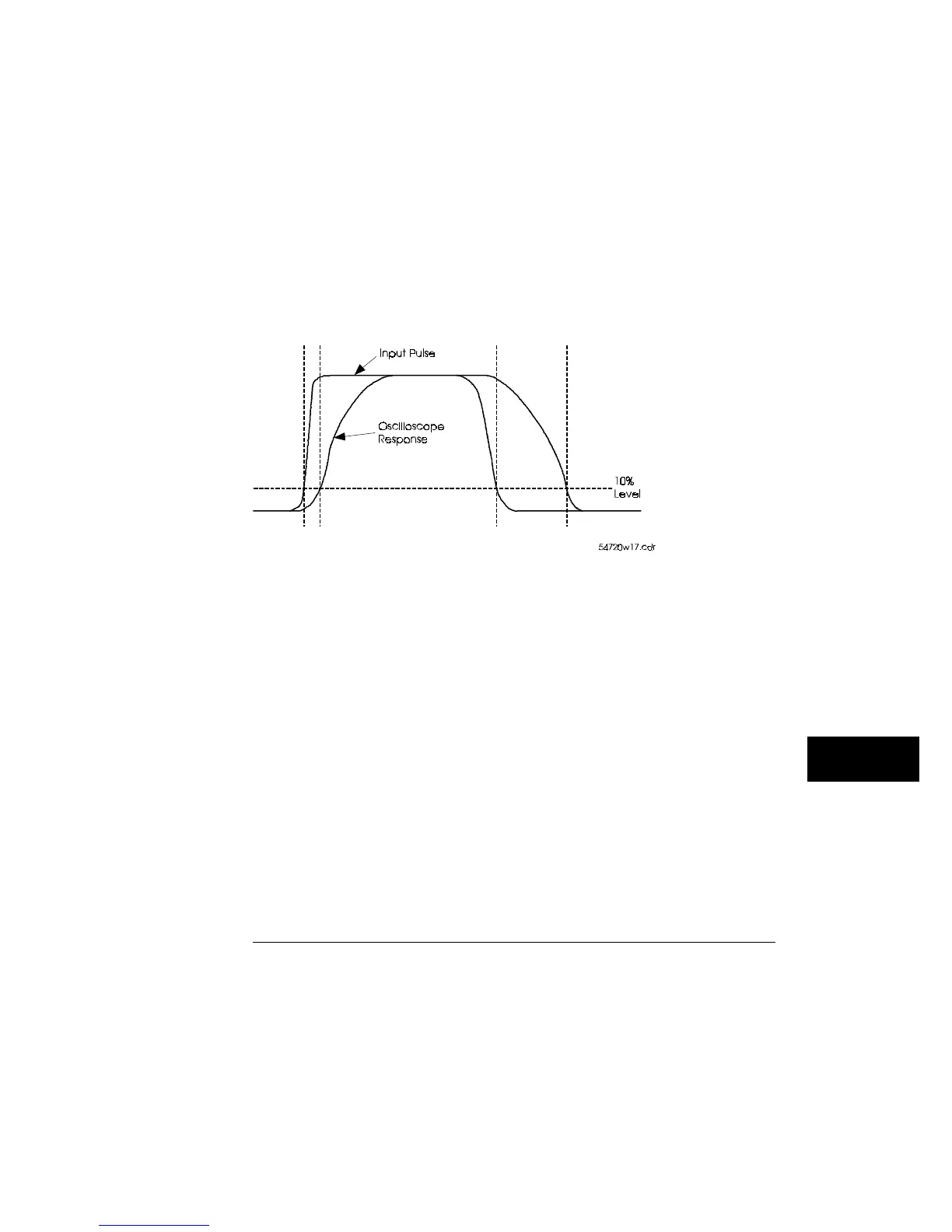
channels is equivalent to measuring the width of a narrow pulse as shown in
figure 13-19.
Error in Pulse Width at 10% Level is Approximately Equal to the Error in 10%–90% Rise Time
Figure 13–19
Measurements
Time-interval measurements
13–43


 To Next Page