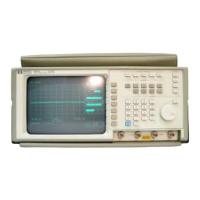
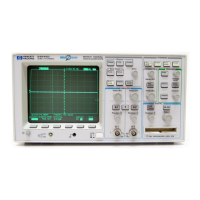
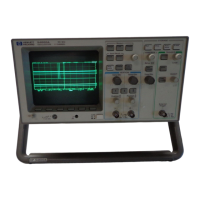
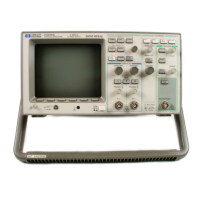
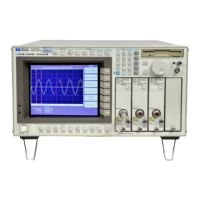
Table 1-1 shows the common characteristics for the channel plug-ins.
Table 1-1
Characteristic HP 54711A HP 54712A HP 54713B HP 54714A HP 54721A HP 54722A
Sample Rate 2 GSa/s 2 GSa/s 2 GSa/s 2 GSa/s 4 GSa/s 8 GSa/s
Bandwidth
in A models 1.5-GHz 1.1-GHz 500-MHz 400-MHz 1.1-GHz 1.5-GHz
in D models 2.0-GHz 1.1-GHz 500-MHz 400-MHz 1.1-GHz 2.0-GHz
Channels 111211
Memory depth
in A models 16K 16K 16K 8K/chan 32K 64K
in D models 64K 64K 64K 32K/chan 128K 256K
Trigger Ext. (2.5-GHz) Internal Internal Internal Internal/Ext. Ext. (2.5-GHz)
Logic trigger No Yes Yes Yes Yes Yes
Max. Sensitivity 20 mV/div 10 mV/div 7 mV/div 7 mV/div 10 mV/div 80 mV/div *
(with software
expansion)
2 mV/div 1 mV/div 1 mV/div 1 mV/div 1 mV/div 8 mV/div
Input resistance
50
Ω
50
Ω
1 M
Ω
/50
Ω
1 M
Ω
/50
Ω
50
Ω
50
Ω
Slots used111124
*The standard 1-2-5 sequence in the 54722A plug-in, which is selected by the
mainframe’s front-panel knob, does not correspond exactly to the attenuator ratios in
the hardware. Refer to the HP 54722A Attenuator Plug-in User’s Reference for more
information about the attenuator ranges.
Use the HP 54711A plug-in when:
•
The signal is repetitive, and you are using the equivalent-time sampling
mode.
•
You need high equivalent-time bandwidth.
•
You can use external triggering, and you need high trigger bandwidth.
•
You can give up logic triggering.
Use the HP 54712A plug-in when:
•
The signal is repetitive, and you are using the equivalent-time sampling
mode.
•
The signal happens once or infrequently, you are using the real-time
sampling mode, and the input signal does not contain any frequency
components above 500 MHz.
•
You need internal triggering.
How the Oscilloscope Works
Choosing Plug-ins
1–18


 To Next Page