[POWER
LEVEL)
MTR: x.xx .
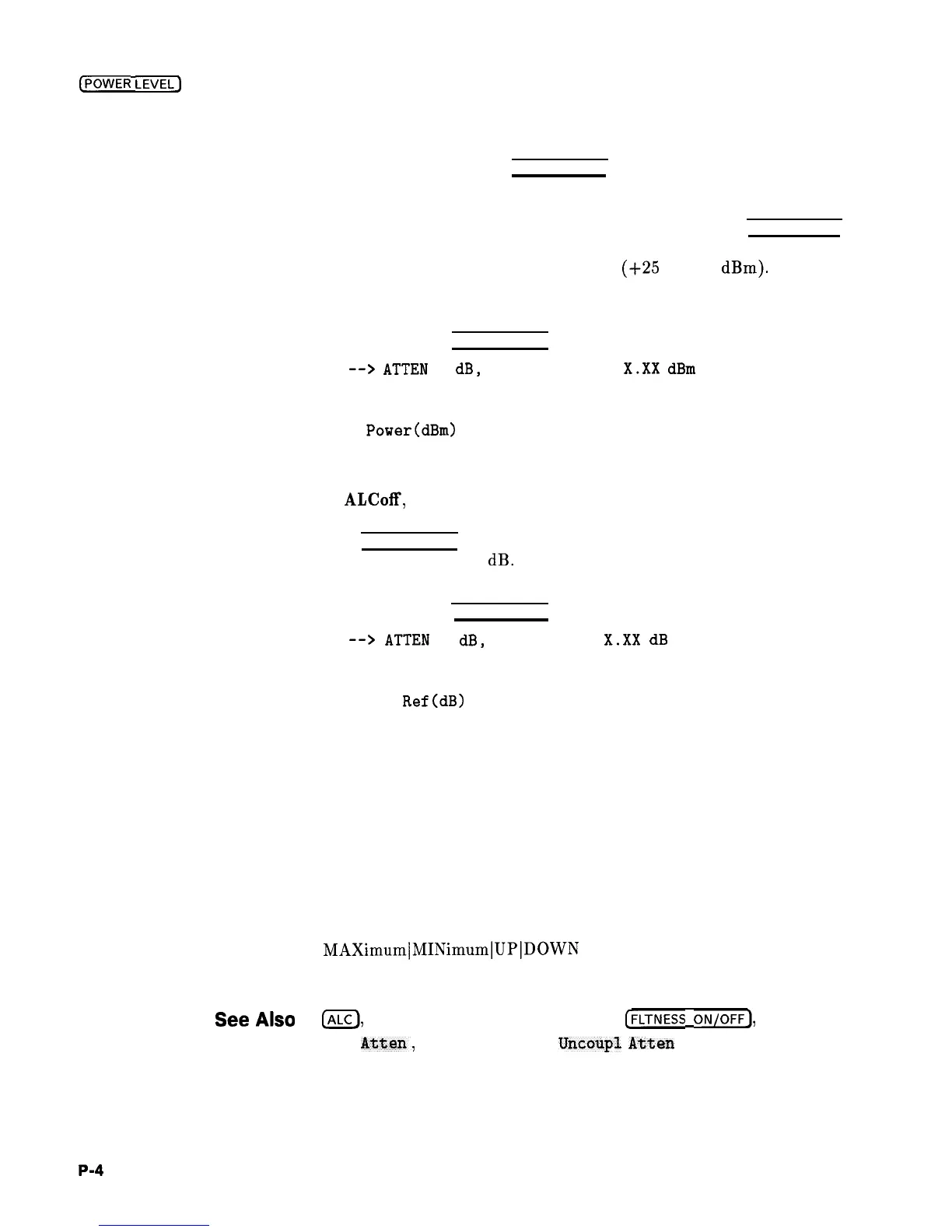
In Normal, Module, the (POWER LEVEL) key controls the output
power of the synthesizer as compared to the feedback voltage from
a millimeter-wave source module. The attenuator (if present) is
automatically uncoupled from the ALC system and the
(POWER LEVEL
key controls the Level DAC and Level Control Circuits (see
Figure A-l) within the ALC level range
(+25
to -20
dBm).
This
mode of operation requires a feedback connection from the module to
the synthesizer through the SOURCE MODULE INTERFACE.
When you press
[POWER LEVEL), the active entry area displays:
-->
ATTEN
X
dB,
MODULE LEVEL:
X.Xx
dBm
,
where X represents a numeric value. The data display area indicates:
Power(dBm)
MDL:
x.xx .
In
ALCoff,
there is no feedback voltage to level the power, so power
level is uncalibrated. A leveling point is not specified in this mode.
The
(POWER LEVEL) key controls the linear modulator directly, from 0
to approximately -80
dB. The attenuator (if present) is automatically
uncoupled from the ALC system.
When you press
[POWER LEVEL), the active entry area displays:
-->
ATTEN
X
dB,
REFERENCE:
X.Xx
dB
,
where X represents a numeric value. The data display area indicates:
Ref(dB)
OFF:
x.xx
and the message line indicates: UNLVLED.
In
Search, any of the leveling points can be specified and used as the
comparison feedback voltage. Basically, this mode operates the same
as ALCoff after the searched-for power level is reached. The active
entry area displays different information depending on the leveling
point chosen.
Programming Codes
SCPI: POWer[:LEVEL] <num>[lvl suffix] or
MAXimum]MINimum]UP]DOWN
Analyzer: PL
See
Also
(ALC),
CONNECTORS, Det Gal Menu,
(FLTNESS
ON/OFF],
Set
Atten,
Tracking Menu,
Uncoupl
Atten
“Programming Typical Measurements,” in Chapter 1.
P-4
Operating and Programming Reference
HP 8360
User’s Handbook


 To Next Page