92
In step 3: To reduce the acceleration of the spin avoiding excessive acceleration. Good for small wheels.
0 : Disablee the Soft Start Function
1 : Enable the Soft Start Function
In step 4: Time among the reaching the balancing speed and the starting of the unbalance measurement.
Measurement delay after spin up can be controlled, by chosen the preferred value. Default value is:
Motorized Wheel Balancer Machine - 0,8
Comments: The selected mode of operation disappear when machine is turned off.
C47 Select machine model
Options: None
Special function: None
Description: Rotate the ! ange or scroll the digital slider to choice the balancer model.
Con" rm the balancer model by pressing Acknowledgment key.
Comments: No further action is required.
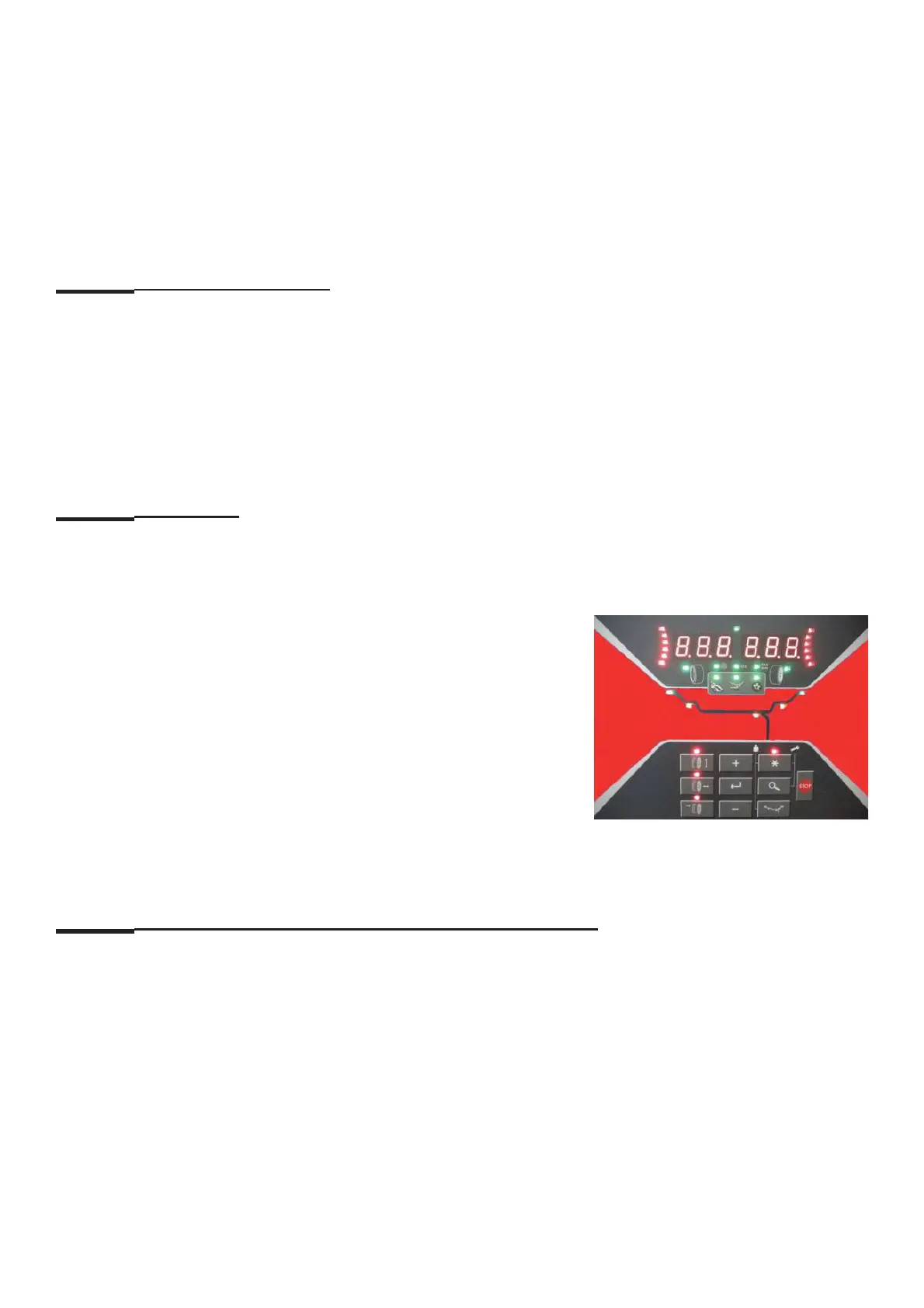
C53 Dispaly test
Options: None
Special function: None
Description: All LEDs must be on.
Comments: None
C54 Checking the incremental encoder on the main shaft
Options: None
Special function:
Low the wheel guard and press to start the spin and press “RETURN” to stop the acceleration of the tire.
Display of measured data/measurement statistics for the incremental encoder/code bar
So that the opto-electronic unit and the code bar can be checked, the main shaft must rotate with constant speed. As
proper performance of the opto-electronic unit is not ensured during execution of C54, speed and direction of rotation
cannot be supervised.
So after the “RETURN” key is pressed to call up the function, the wheel guard must be lowered in to turn on the motor,
operating under full voltage and with the starting capacitor turned on until the “RETURN” key is released. This should
be done when the " nal speed is reached.
Once the “RETURN” key is pressed, the starting capacitor is turned off and motor voltage is reduced so that speed
can be easily maintained.
If no signal is identi" ed in one or both channels, no reading is given for the relative channel and for the phase shift.



 To Next Page