34410A/11A/L4411A User’s Guide 103
Measurement Tutorial 4
DC Measurement Considerations
Thermal EMF Errors
Thermoelectric voltages are the most common source of error in low–level dc voltage
measurements. Thermoelectric voltages are generated when you make circuit
connections using dissimilar metals at different temperatures. Each metal–to–metal
junction forms a thermocouple, which generates a voltage proportional to the junction
temperature. You should take the necessary precautions to minimize thermocouple
voltages and temperature variations in low–level voltage measurements. The best
connections are formed using copper–to–copper crimped connections, as the
multimeter’s input terminals are a copper alloy. The table below shows common
thermoelectric voltages for connections between dissimilar metals.
Loading Errors (dc volts)
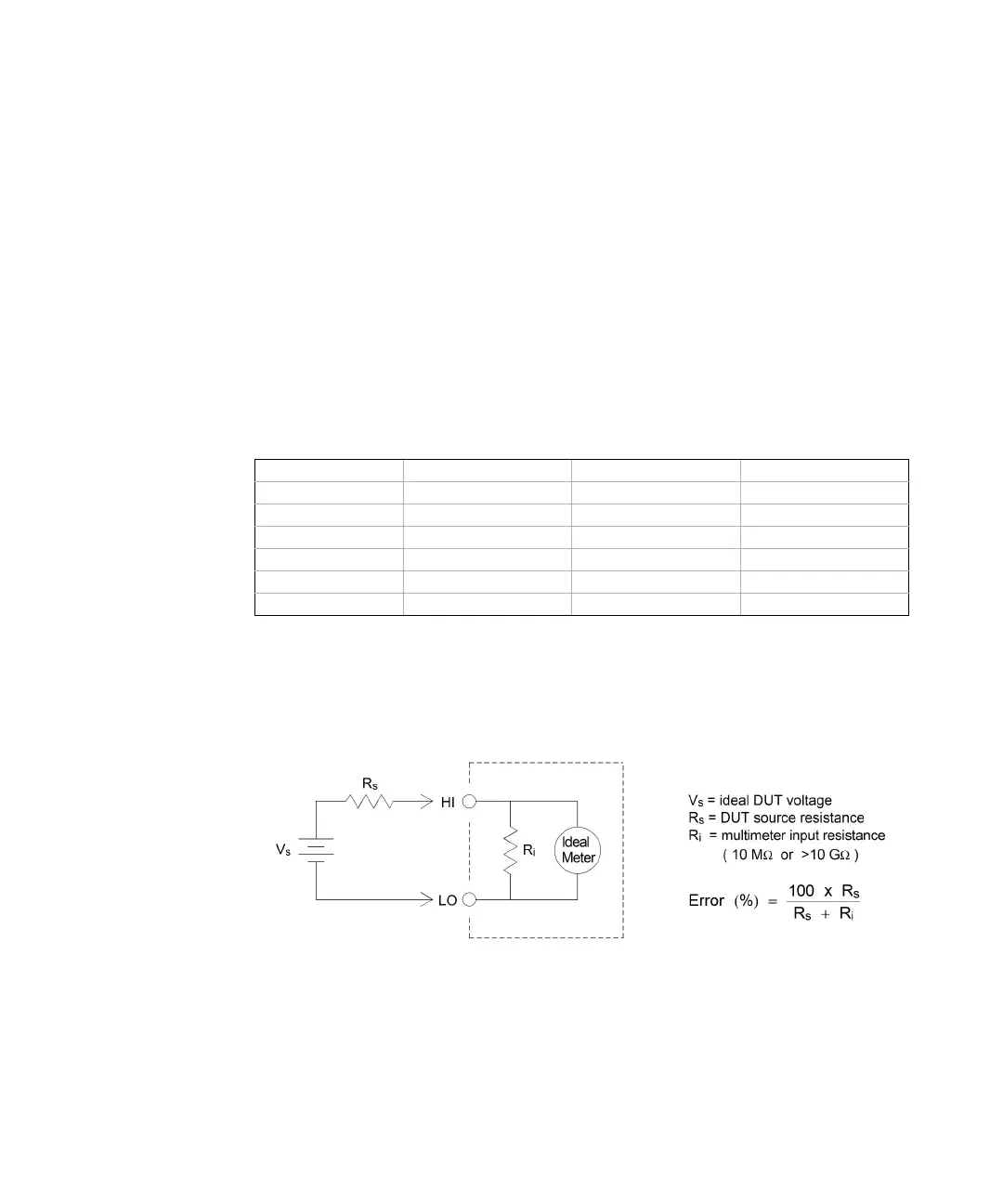
Measurement loading errors occur when the resistance of the device–under–test (DUT)
is an appreciable percentage of the multimeter's own input resistance. The diagram
below shows this error source.
To reduce the effects of loading errors, and to minimize noise pickup, you can set the
multimeter's input resistance to >10 GΩ (the HI–Z setting) for the 100 mVdc, 1 Vdc,
and 10 Vdc ranges. The input resistance is maintained at 10 MΩ for the 100 Vdc and
1000 Vdc ranges.
Copper to – Approx. μV / °C Copper to – Approx. μV / °C
Cadmium-Tin Solder 0.2 Aluminum 5
Copper <0.3 Tin-Lead Solder 5
Gold 0.5 Kovar or Alloy 42 40
Silver 0.5 Silicon 500
Brass 3 Copper-Oxide 1000
Beryllium Copper 5


 To Next Page