112 34410A/11A/L4411A User’s Guide
4 Measurement Tutorial
Estimating High–Frequency (Out–of–Band) Error
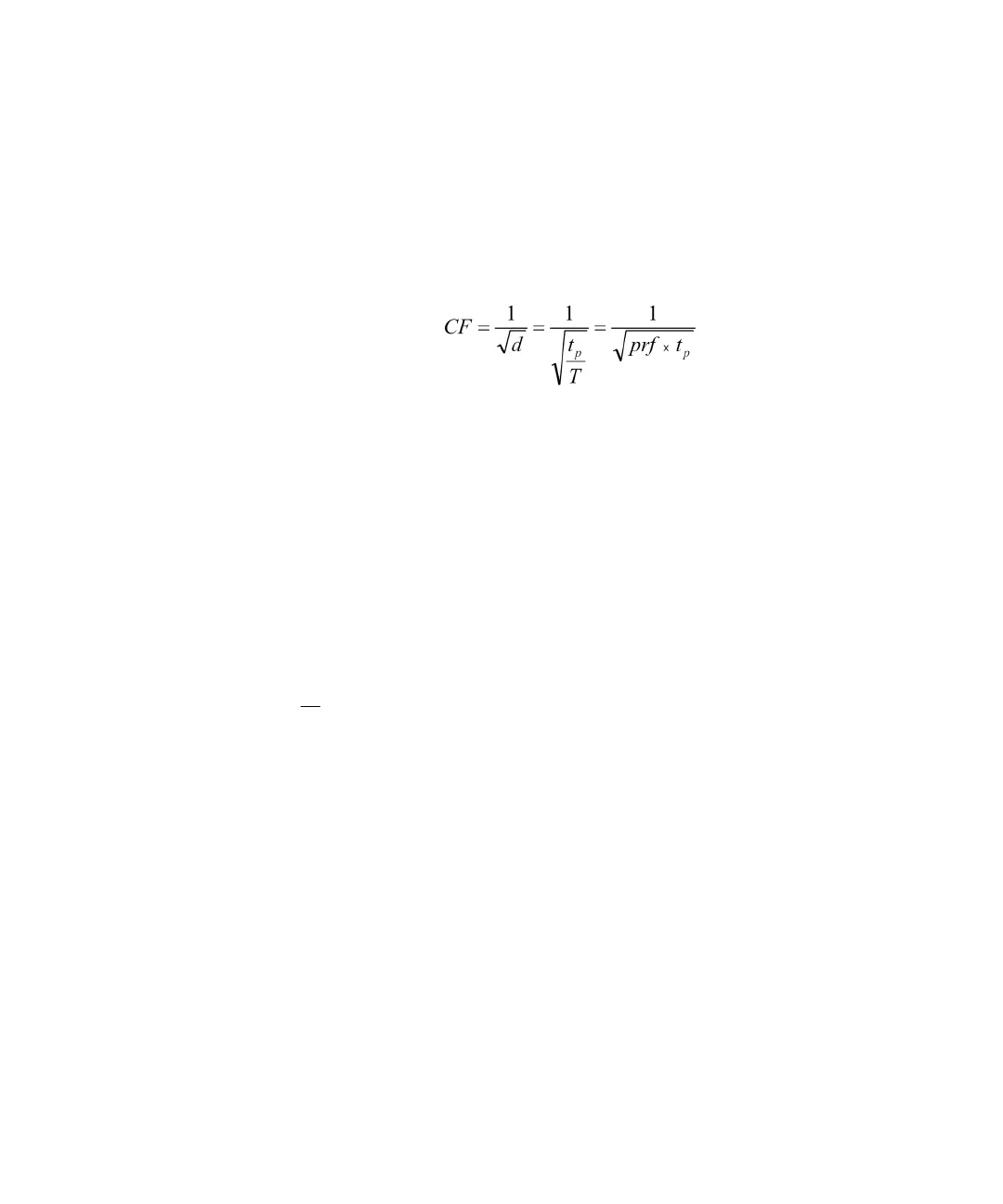
A common way to describe signal waveshapes is to refer to their “Crest Factor”. Crest
factor is the ratio of the peak value to rms value of a waveform. For a pulse train, for
example, the crest factor is approximately equal to the square root of the inverse of the
duty cycle.
Notice that crest factor is a composite parameter, dependent upon the pulse–width and
repetition frequency; crest factor alone is not enough to characterize the frequency
content of a signal.
Traditionally, DMMs include a crest factor derating table that applies at all frequencies.
The measurement algorithm used in the 34410A/11A/L4411A multimeters is not
inherently sensitive to crest factor, so no such derating is necessary. With this
multimeter, as discussed in the previous section, the focal issue is high–frequency signal
content which exceeds the multimeter’s bandwidth.
For periodic signals, the combination of crest factor and repetition rate can suggest the
amount of high–frequency content and associated measurement error. The first zero
crossing of a simple pulse occurs at:
This gives an immediate impression of the high-frequency,content by identifying where
this crossing occurs as a function of crest factor:


 To Next Page