104 34410A/11A/L4411A User’s Guide
4 Measurement Tutorial
Noise Rejection
Rejecting Power–Line Noise Voltages
A desirable characteristic of integrating analog–to–digital (A/D) converters is their
ability to reject power–line related noise present with dc input signals. This is called
normal mode noise rejection, or NMR. The multimeter achieves NMR by measuring the
average dc input by "integrating" it over a fixed period. If you set the integration time to
a whole number of power line cycles (PLCs), these errors (and their harmonics) will
average out to approximately zero.
The multimeter provides four integration selections (1, 2, 10 and 100 PLCs) that achieve
NMR. The multimeter measures the power–line frequency (50 Hz or 60 Hz), and then
determines the corresponding integration time. For a complete listing of NMR,
approximate added rms noise, reading rate, and resolution for each integration setting,
see the Performance vs. Integration Time table on page 130.
You can also program specific apertures, using the INTEGRATION settings, to reject
undesired signal frequency components.
Common Mode Rejection (CMR)
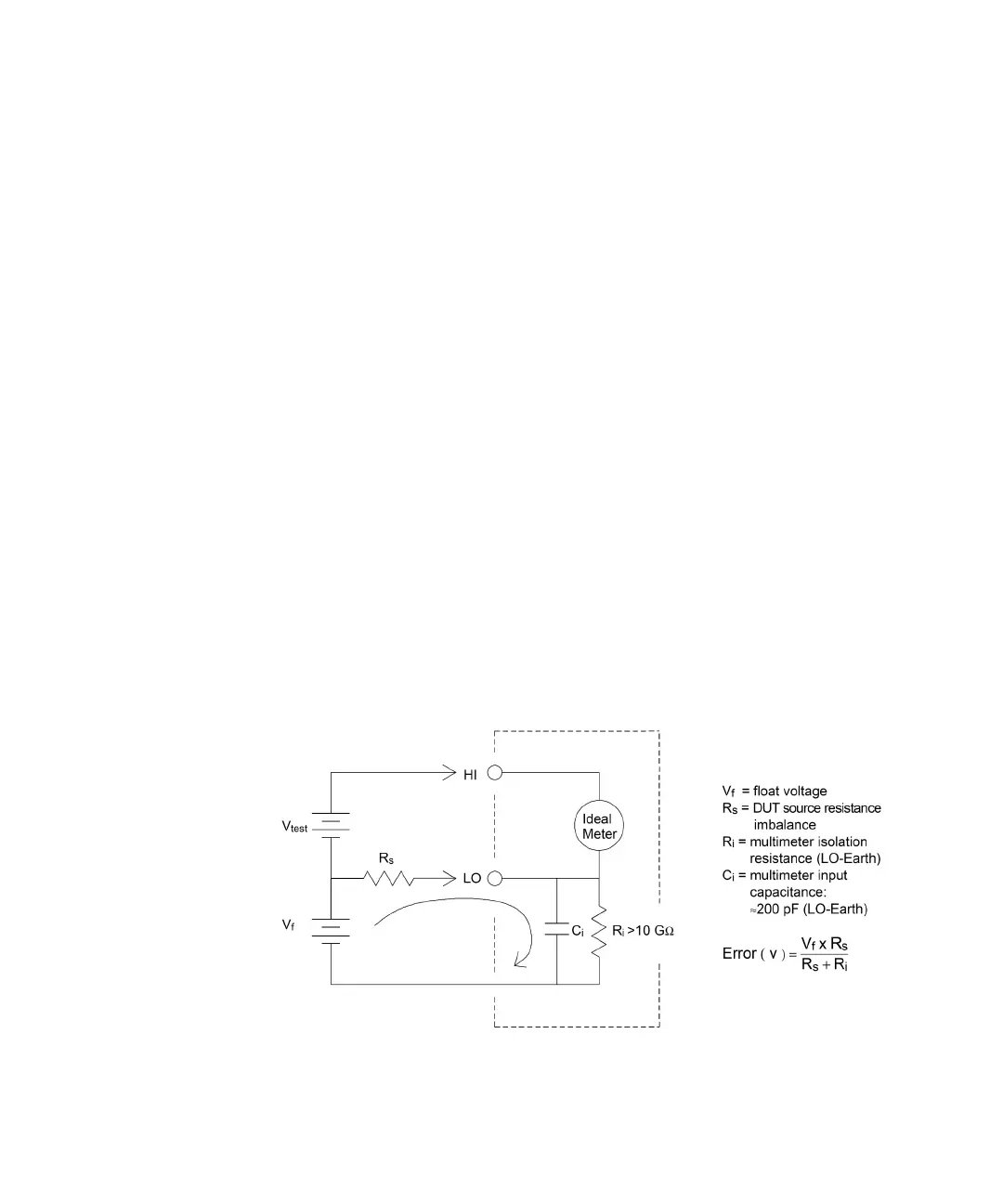
Ideally, a multimeter is completely isolated from earth–referenced circuits. However,
there is finite resistance between the multimeter's input LO terminal and earth ground, as
shown below. This can cause errors when measuring low voltages which are floating
relative to earth ground.


 To Next Page