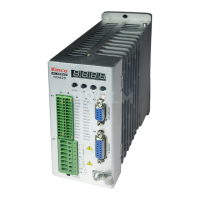
Kinco FD3&CD3 User Manual
Stiffness should be adjusted according to the actual requirement.
If response is too slow increase stiffness. If oscillation or noise increases reduce stiffness.
If the command from the controller (e.g. PLC) is unreasonable or inappropriate for the machine, some filters
should be modified in order to reduce oscillation (see chapter 7.3 manual tuning).
Information
When the stiffness setting or the inertia ratio increases Kvp to a value of greater than 4000, it’s
not useful to increase stiffness any more, and bandwidth will be decreased if the inertia ratio is
further increased. If changing stiffness via communication, WriteFUN_CTL(3041.05) must be
set to 1 first, and be set back to 0 after stiffness has been changed.
7.3 Manual tuning
If the auto-tuning function does not support the actual application, or if the application has a gap, inertia
changes or a very soft connection, manual tuning is the right choice.
The manual tuning process makes use of test motion. Match the controller to the actual application on the
basis of experience with the application and a given scope of data by changing loop gain and filter settings.
Since current loop parameters are calculated internally based on the motor parameters, there is normally no
need to set current loop parameters manually.
7.3.1 Tuning of the velocity loop
Steps required for adjustment:
Ensure limiting of velocity loop bandwidth
Velocity loop bandwidth limits position loop bandwidth and thus adjustment of velocity loop bandwidth is
important.
Limitation of velocity loop bandwidth can be judged from several viewpoints.
1) According to oscillation and noise sensed with the finger and the ears: This method is based on
experience, but it’s efficient. The user can listen to or touch the machine, at the same time increasing and
reducing the kvp. When an acceptable maximum kvp value is found, the current setting can be specified as
the maximum velocity loop bandwidth.

 To Next Page
 Loading...