8 MDS iNET 900 User’s Guide MDS 05-2806A01, Rev. A
The MDS iNET 900 trades higher speed for longer range. Commercial
802.11b solutions were designed to provide services to relatively small
areas such as offices, warehouses and homes. They provide high data
rates but have limited range. The MDS iNET 900 uses more power, a
different frequency band, higher sensitivity, and a narrower channel to
concentrate the radio energy and reach further distances. This is unlike
commercial spread-spectrum products. The MDS iNET 900 is designed
for industrial operation from the ground up.
IP-based devices include a new breed of more powerful RTU/PLC
devices as well as other services such as Web-based video monitoring,
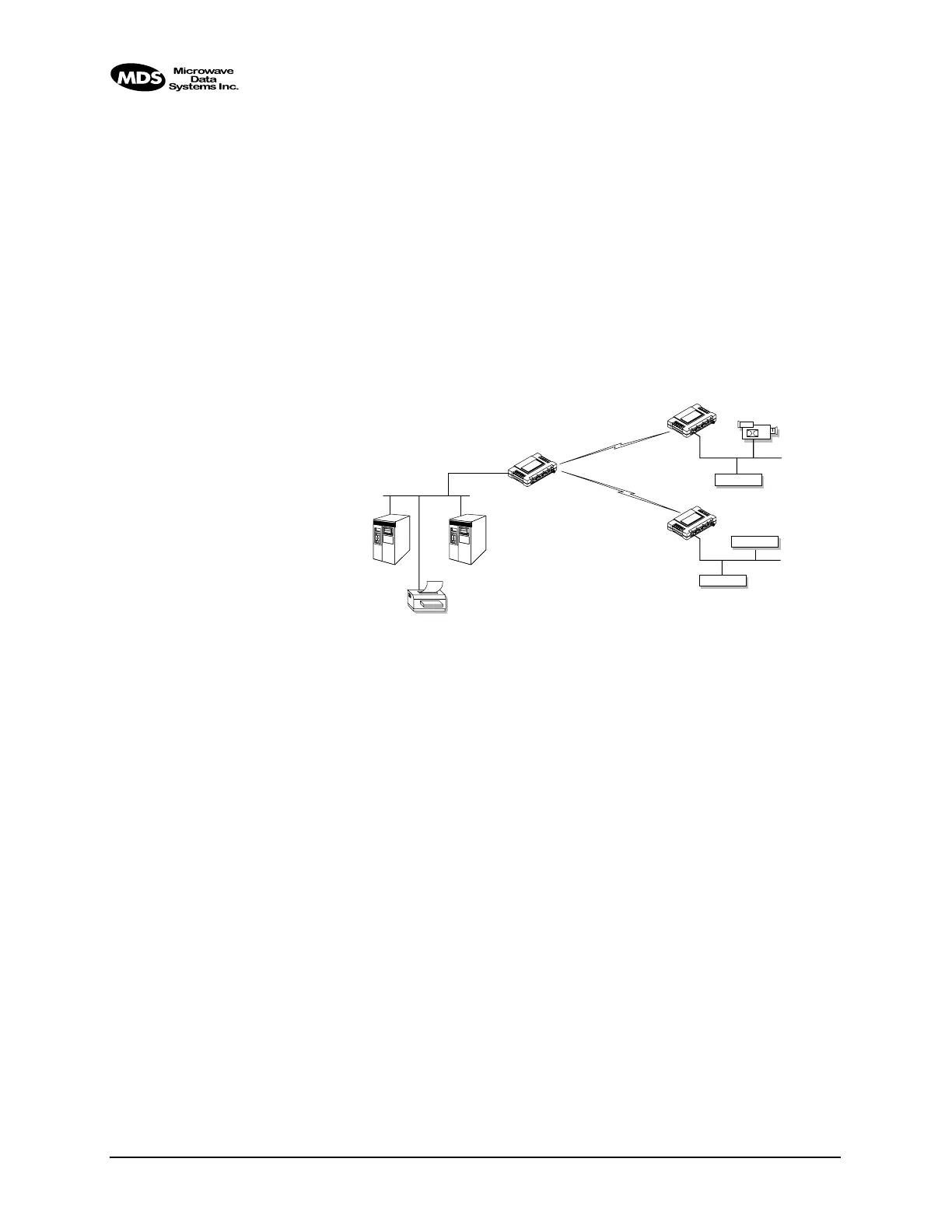
security applications, and voice over IP. Figure 1-6 shows a typical net-
work.
Invisible place holder
Figure 1-6. Extended-Range LAN with Mixed Applications
1.2.6 Upgrading Older Wireless Network with Serial
Interfaces
Millions of wireless data products have been sold in the last two decades
for licensed and license-free operation, many of them manufactured by
Microwave Data Systems. There are several ways that these systems can
benefit from the more flexible MDS iNET 900 equipment—more flex-
ible serial and Ethernet interfaces, and higher data throughput.
MDS iNET 900 units are well suited to replace leased or dial-up lines,
or existing 900 MHz data transceivers by taking advantage of the
iNET’s serial and Ethernet interfaces.
Replacing Legacy Wireless Products
In most cases, legacy radio transceivers supporting serial-interface
equipment can be replaced with MDS iNET 900 units. This equipment
can be connected to the MDS iNET 900 units through the
COM1 or
COM2
port with a DB-25 to DB-9 cable wired for EIA-232 signaling.
The
COM2 port supports all standard EIA-232 signaling and acts as a
data-terminal equipment device (DTE).
NMS Control
Point
SCADA Host
Modbus/IP
i
NET 900
Access Point
i
NET 900
Remote Bridge
Printer
IP/Ethernet
IP/Ethernet
i
NET 900
Remote Bridge
IP/Ethernet
IP Camera


 To Next Page