10 MDS iNET 900 User’s Guide MDS 05-2806A01, Rev. A
Option 1—Using two iNET units to form a repeater station
Although the range between iNET 900 units can achieve up to 50 km (30
miles) over favorable terrain, it is possible to extend the range consider-
ably by connecting two units together at one site in a “back-to-back”
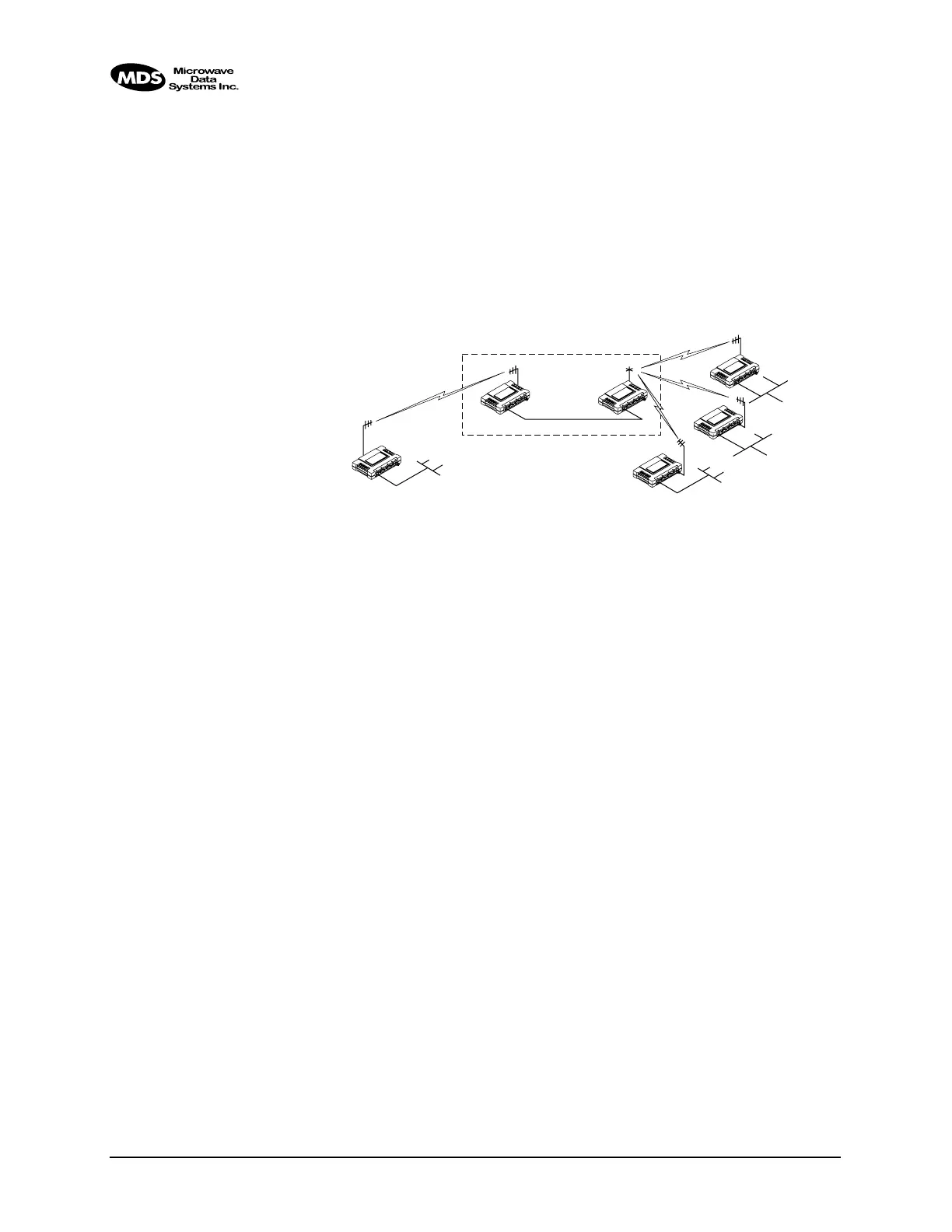
fashion to form a repeater, as shown in Figure 1-7. This arrangement
should be used whenever the objective is to utilize the maximum range
between stations. In this case, using high-gain Yagi antennas at each
iNET location will provide more reliable communications than their
counterparts—omnidirectional antennas.
Invisible place holder
Figure 1-7. Typical LAN with an iNET 900 repeater link
Overview
Two MDS iNET 900 radios may be connected “back-to-back” through
the
LAN Ports to form a repeater station. (The cable must be a
“cross-over” Ethernet cable for this to work). This configuration is
sometimes required in a network that includes a distant Remote that
would otherwise be unable to communicate directly with the Access
Point station due to distance or terrain.
A repeater works by re-transmitting data from the outlying remote site
to the Access Point and vice versa. It introduces a small amount of
end-to-end transmission delay, but this is not a problem in most systems.
The geographic location of a repeater station is especially important. A
site must be chosen that allows good communication with both the
Access Point and the outlying Remote site. This is often on top of a hill,
building, or other elevated terrain from which both sites can be “seen”
by the repeater station antennas. A detailed discussion on the effects of
terrain is given in Section 5.1.2, Site Selection (beginning on Page 99).
The following paragraphs contain specific requirements for repeater
systems.
Antennas Two antennas are required at this type of repeater station—one for each
radio. Measures must be taken to minimize the chance of interference
between these antennas. One effective technique for limiting interfer-
ence is to employ vertical separation. In this arrangement, assuming
both are vertically polarized, one antenna is mounted directly over the
other, separated by at least 10 feet (3 Meters). This takes advantage of
the minimal radiation exhibited by most antennas directly above and
below their driven elements.
iNET 900
Access Point
iNET Remote
iNET 900
Remote
iNET 900
Remote
iNET 900
Remote
iNET 900
Access
Point
LAN/WAN
REPEATER
Crossover Cable
LAN
LAN
LAN
POINT-TO-POINT LINK


 To Next Page