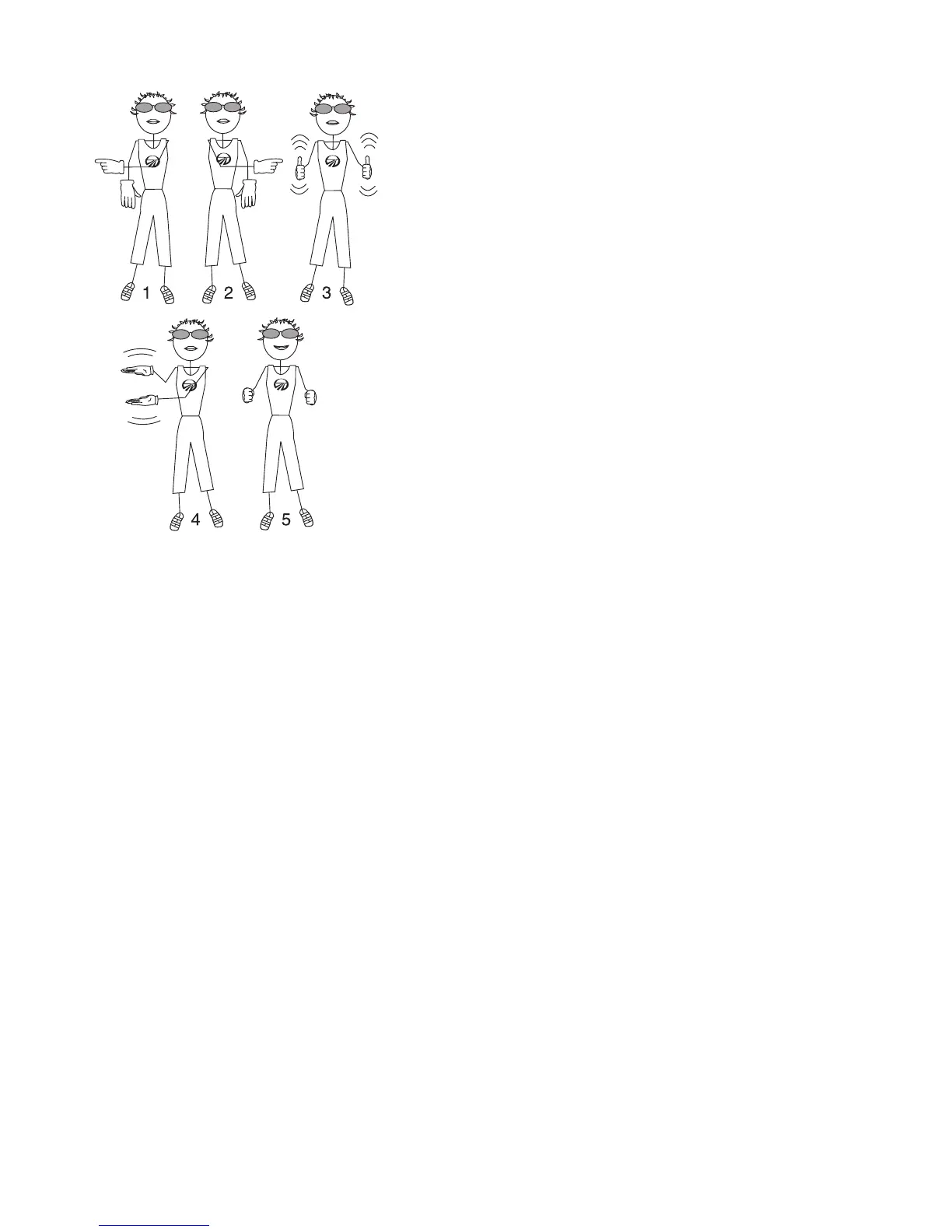
1. Co-pilot uses left hand and arm held horizontal,
with forefinger pointing right, to direct rear of
motorhome to the right.
2. Co-pilot uses right hand and arm held horizon-
tal, with forefinger pointing left, to direct rear
of motorhome to the left.
3. Co-pilot uses both arms and hands parallel with
thumbs pointing up and to rear in a waving ver-
tical motion. This signals driver to maintain a
straight back direction.
4. Co-pilot hodls arm vertically, hands open with
palms facing one another. Start with a wide sepa-
ration, gradually closing distance of hands, in a
rate appropriate to vehicle speed, to indicate
amount of distance to the stop point.
5. Closed fists indicates STOP.
Backing Up Trailers:
Trailers have only one pivot point. Trailers may be backed up. Towed vehi-
cles using a tow bar or tow dolly have more than one pivoting point which
makes this type of equipment not suitable for backing. If using this type of tow-
ing equipment, plan ahead. Park safely along the road and walk a distance if
necessary to avoid a possible back up situation. Avoid putting the motorhome
and tow vehicle in a backing situation. To back up this combination, completely
disconnect the tow vehicle from motorhome. Trying to back up the motorhome
with a tow vehicle connected will result in damage to the motorhome, tow vehi-
cle and towing device.
The same rules for backing a motorhome may be applied when backing a
trailer. When preparing to back a trailer into a space, maneuver the motorhome
sweeping wide, then turn back to the opposite direction. This sets the
motorhome and trailer in a position to maneuver the trailer into the space. When
backing up a trailer, the driver may become disoriented with the direction of the
steering wheel in relation to the direction of the trailer. The bottom of the steer-
ing wheel must be moved in the desired direction of the trailer. For example: If
the desired direction of the trailer is left, rotate the bottom of the steering wheel
left. If the trailer moves in an undesired direction, use a short “pull-up” method,
pulling forward just far enough to align the trailer with the space. The co-pilot
should stand safely at the left rear corner of the trailer within view of the driver
in the road side mirror, using the five hand signals for guiding.
Driving & Safety
---------------------------------------------------------------------------------------------------------------------------------------------------------------------------------------------------------------------------------------------------------------------------------------------------------------------
DIPLOMAT
2•34
OM020082.eps



 To Next Page