7 Direction Finding Mode
132 IDA-3106 Narda
To determine the bearing of a signal source:
1. Set the measurement parameters as desired.
2. Check the polarization (horizontal / vertical):
– Tip the antenna by 90°: The maximum signal strength is displayed
when the polarization is correct.
– If necessary, change the position of the antenna module in the holder.
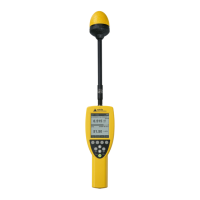
3. Slowly pan the antenna horizontally until the bargraph indicates the
maximum level (for information on how to pan the antenna, see Holding
and panning the directional antenna properly on page 266). The
maximum value display on the bargraph helps you to find the bearing
with the highest signal level.
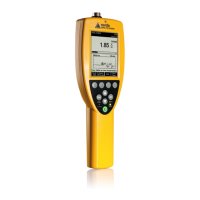
4. To hold the measurement value, press the button on the antenna handle
or press the Hold key on the Basic Unit.
Hold flashes on the screen.
5. Press the SAVE key on the Basic Unit to save the measurement results.
A window indicates the save process and the index number under
which the current measurement values are saved.
NOTE: You can also save measurement values without using the Hold function.
6. Press the button on the antenna handle or the Hold key on the Basic
Unit again to unfreeze the measurement value.
7. Make further measurements and save the results as required. Each time
you save results, they are stored as a separate data set or data subset
(for localization) with consecutive index numbers.
7.3.1 Using the audio function
Direction Finding • Audio
The Tone Search function provides assistance for manual direction finding
by means of audible signals. Two modes are provided for this: Bargraph
and Leveling.
Tone Search can also be used at the same time as demodulation of audio
signals.
NOTE: You can perform a tone search without a bargraph with the function
Horizontal Scan: On (see Horizontal Scan on page 134).
Bargraph
In Bargraph mode, the measured signal level is also output as an audible
signal. The pitch corresponds to the signal strength.
• The stronger the signal, the higher the tone.
• The weaker the signal, the lower the tone.


 To Next Page