129
Sequence Output Instructions Section 3-3
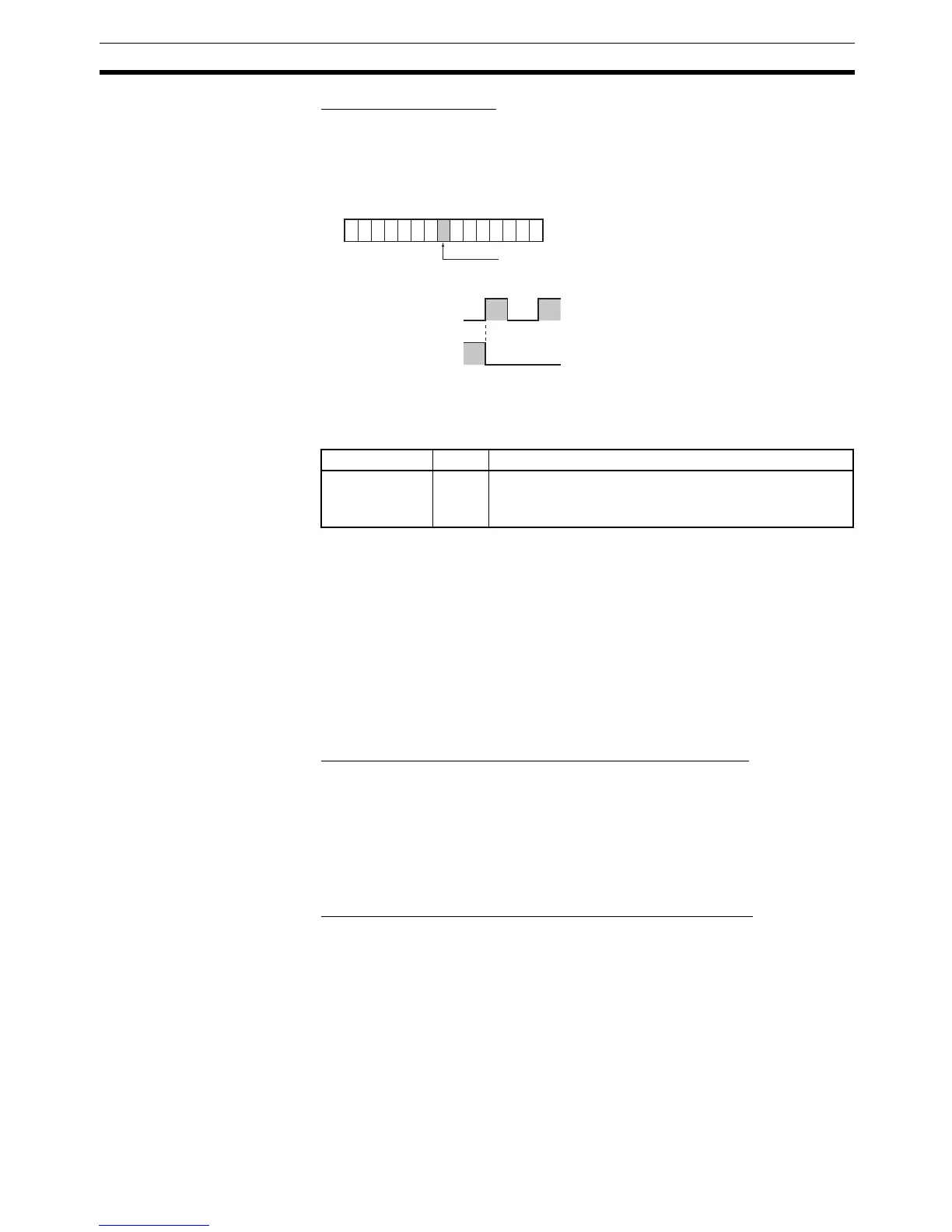
Operation of RSTB(533)
RSTB(533) turns OFF bit N of word D when the execution condition is ON.
The status of the bit is not affected when the execution condition is OFF. (Use
SETB(532) to turn ON the bit.) Unlike RST, RSTB(533) can turn OFF a bit in
the DM area.
Bits turned OFF by RSTB(533) can be turned ON by any other instruction, not
just SETB(532).
Flags
Precautions SETB(532) and RSTB(533) cannot set/reset timers and counters.
When SETB(532) or RSTB(533) is programmed between IL(002) and
ILC(003) or JMP(004) and JME(005), the status of the specified bit will not be
changed if the program section is interlocked or jumped, i.e., when the inter-
lock condition or jump condition is OFF.
SETB(532) and RSTB(533) have immediate refreshing variations
(!SETB(532) and !RSTB(533)). When an external output bit has been speci-
fied in one of these instructions, any changes to the specified bit will be
refreshed when the instruction is executed and reflected immediately in the
output bit for the CPU Unit built-in output.
Differences between SET/RSET and SETB(532)/RSTB(533)
The SET and RSET instructions operate somewhat differently from
SETB(532) and RSTB(533).
1. The instructions operate in the same way when the specified bit is in the
CIO, W, H, or A Area.
2. The SETB(532) and RSTB(533) instructions can control bits in the DM Ar-
ea, unlike SET and RSET.
Differences between OUTB(534) and SETB(532)/RSTB(533)
The OUTB(534) instruction operates somewhat differently from SETB(532)
and RSTB(533).
1. The SETB(532) and RSTB(533) instructions change the status of the
specified bit only when their execution condition is ON. These instructions
have no effect on the status of the specified bit when their execution con-
dition is OFF.
2. The OUTB(534) instruction turns ON the specified bit when its execution
condition is ON and turns OFF the specified bit when its execution condi-
tion is OFF.
ON
OFF
ON
OFF
15
This bit is turned OFF.
Execution condition
Bit N of word D
Name Label Operation
Error Flag ER ON if N is not within the specified range of 0000 to 000F
(&0 to &15).
OFF in all other cases.


 To Next Page