463
Special Math Instructions Section 3-13
Cosine Function (C: #0001)
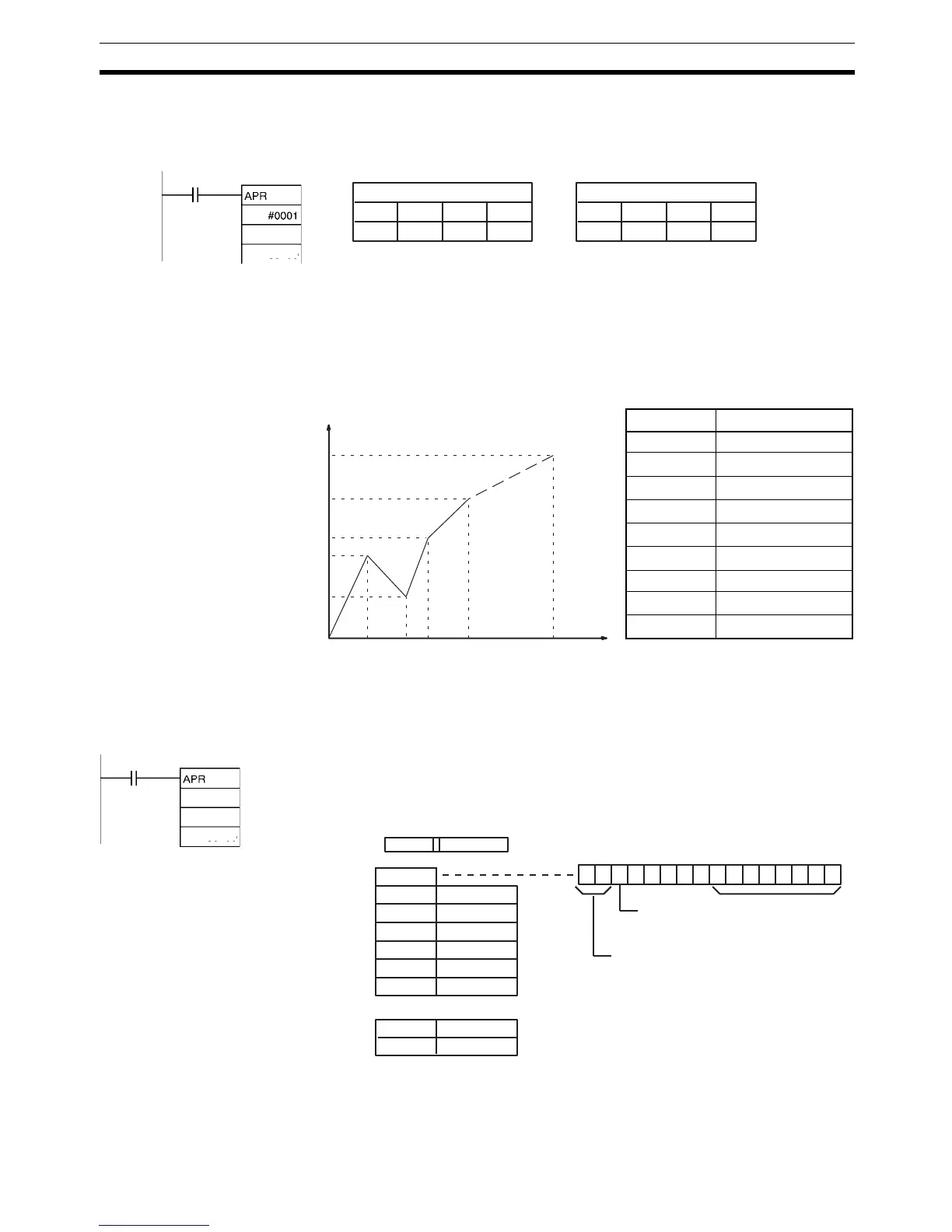
The following example shows APR(069) used to calculate the cosine of 30°.
(SIN(30) = 0.8660)
Linear Extrapolation (C: Word Address)
Using 16-bit Unsigned BCD or Binary Data
APR(069) processes the input data specified in S based on the control data in
C and the line-segment data specified in the table beginning at C+1. The
result is output to D.
•Y
n
=f(X
n
), Y
0
=f(X
0
)
• Be sure that X
n–1
< X
n
in all cases.
• Input all values of (X
n
, Y
n
) as binary data.
This example shows how to construct a linear extrapolation with 12 coordi-
nates. The block of data is continuous, as it must be, from D1000 to D1026 (C
to C + (2
× 12 + 2)). The input data is taken from CIO 1000, and the result is
output to CIO 1001.
S: D10 R: D200
010
1
10
0
10
–1
10
–1
10
–2
10
–3
10
–4
0300 8 6 6 0
0.00
D10
D200
Source data Result
Set the source data in 10
1
degrees.
(0000 to 0900, BCD)
Result data has four significant digits,
fifth and higher digits are ignored.
(0000 to 9999, BCD)
Word
Coordinate
C+1 Xm (max. X value)
C+2 Y
0
C+3 X
1
C+4 Y
1
C+5 X
2
C+6 Y
2
↓ ↓
C+(2m+1) X
m
(max. X value)
C+(2m+2) Y
m
Y
0
Y
2
Y
1
Y
3
Y
4
Y
m
X
0
X
1
X
2
X
3
X
4
X
m


 To Next Page