USER'S MANUAL
Description
I-Max Touch (110-120V) (Rev. 0)
12
4.2 Functions, models and versions
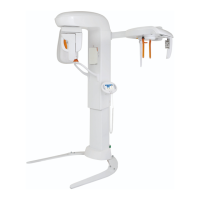
The I-Max Touch, produced by Owandy, is a complete panoramic system,
which enables to perform all X-rays commonly necessary in dental field
(except for endoral X-rays).
In some versions, certain examination modes are not available but the
device (thanks to its computerised control system) can be expanded and
updated with new releases, directly at the Dentist premises.
The basic version performs Panoramic, Emi-panoramic, Reduced dose
Panoramic, Frontal dentition, Improved orthogonality Panoramic Sinus
and TMJ examinations.
Optional functions enable the system to perform the following additional
examinations:
• CEPH
Allows you to carry out the following examinations:
− CEPH exam in different formats
− CARPUS exam.
4.2.1 Basic version
The basic version enables to perform the following examinations:
• Panoramic Adult or Child, with 3 Sizes and 3 Types of Biting for a
total of 18 combinations in Automatic selection; in manual selection
it is possible to select high voltage between 60kV and 86kV, in 2kV
steps and anodic current from 6 mA to 10 mA in 1 mA steps.
• Sinus enables to perform images of the paranasal sinuses with front
projection (postero/anterior).
• TMJ mouth closed/open in lateral projection.
• The right or left Emi-panoramic is used when the patient is known to
have a problem only on one side of the arch, in order to reduce the
radiation.
• The reduced dose Panoramic reduces the dose radiated on the
dentition by excluding the TMJ's ascending rami from the exams.
• The frontal dentition enables to perform examinations of the front
part (roughly from canine to canine).
• The Panoramic with improved orthogonality reduces the overlap of
the teeth, thereby improving the diagnosis of interproximal decay.


 To Next Page