User Guide
DVS-21
02/2018 • V.1.0 • L. Wolle
© 2017 ProCom
®
Professional Communication & Service GmbH • Technical changes reserved.
9.16 Remote - Intercom
Program for intercom in split systems.
The control of the connection takes place via a Call line and Busy line at least! These lines are identical in
the source and destination systems! All further options are optional.
Handling of priorities (see Section 9.1)
Audio compression method with which the codec handles the actual connection.
The options are: µLaw (default), ADPCM (7kHz) and aLaw (see Section 9.1)
The connection is established and kept single-sided until the key is pressed
once more. The remote station must have higher priority and can reverse the
direction and reply.
Connection is broken after the preset time
AF transmission takes place via a multi-channel digital connection (Address and
port for control and AF are identical)
Selection of the type of call station (ProCom- or Analog- call stations).
Input/call station (Setting Own)
Address and port of the module to which the call station is connected and the
line (key) that is used. (4NSA)
Input/call station (Setting Analog)
Address and port of the module to which the AF line of the call station is
connected. (4NPA)
Address, port and line of the module to which the control line of the call station is
connected. (24LI)
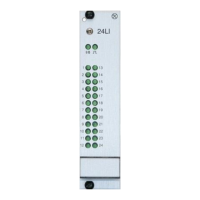
The 24LI module converts a call telegram into active flashing. This is standard
for the signaling of a call. This flashing may however be undesirable if the
source is not a station but an active third-party system. Flashing is suppressed
by deactivating the option.
In the case of analog stations, the microphone amplifier is usually switched on
internally by the activation of a PTT key. As control takes place by means of the
control station in this operating mode, the microphone amplifier must be
switched on by a switching voltage. The V-Point-Line specifies which output of
the associated 24LI supplies this switching voltage.
Time for the key illuminates (flashing) after missed calls


 To Next Page