User Guide
DVS-21
02/2018 • V.1.0 • L. Wolle
© 2017 ProCom
®
Professional Communication & Service GmbH • Technical changes reserved.
9.18 Remote - AllCall
AllCall is a simultaneous, single-sided speech connection to multiple stations and loudspeaker lines.
The Remote - AllCall program can replace the AllCall program without, however, the option of using the
pre-announcement chime/alarm tone.
All destinations to which a voice connection with the specific station exists via one of the following
programs, can be integrated. (IC Intercom, IC Group, PA Public address, ZZ connection).
In addition, an outgoing connection can be programmed via a long-distance line. In the destination
system, the Remote - Intercom program can react by means of its AllCall-Line.
Handling of priorities (see Section 9.1)
Audio compression method with which the codec handles the actual connection.
The options are: µLaw (default), ADPCM (7kHz) and aLaw (see Section 9.1)
Selects the type of call station (ProCom or analog call stations).
Input/call station (Setting Own)
Address and port of the module to which the call station is connected and the line
(key) that is used. (4NSA)
Input/call station (Setting Analog)
Address and port of the module to which the AF line of the call station is connected.
(4NPA)
Address and port of the module to which the control line of the call station is
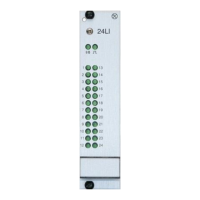
connected. (24LI)
Address and port of the module to which the long-distance line for the transmission
of AF is connected.
Transmission line controlling
Address and port of the module to which the long-distance line for control
transmission is connected.
Line for transferral of the Busy status.
AllCall-Line
Destination of one or more programs Remote - Intercom in a remote system.
The line is switched on if the program is activated. For example, relays can be
switched or keys can be illuminated.
[IN] The program can be turned off by this flag or switching on can be prevented.
[IN] The program can be switched on by this flag. AF channels can be taken over.
[OUT] The flag is switched on if the program is activated. This enables further
programs to be activated for adaptation to specific requirements.


 To Next Page