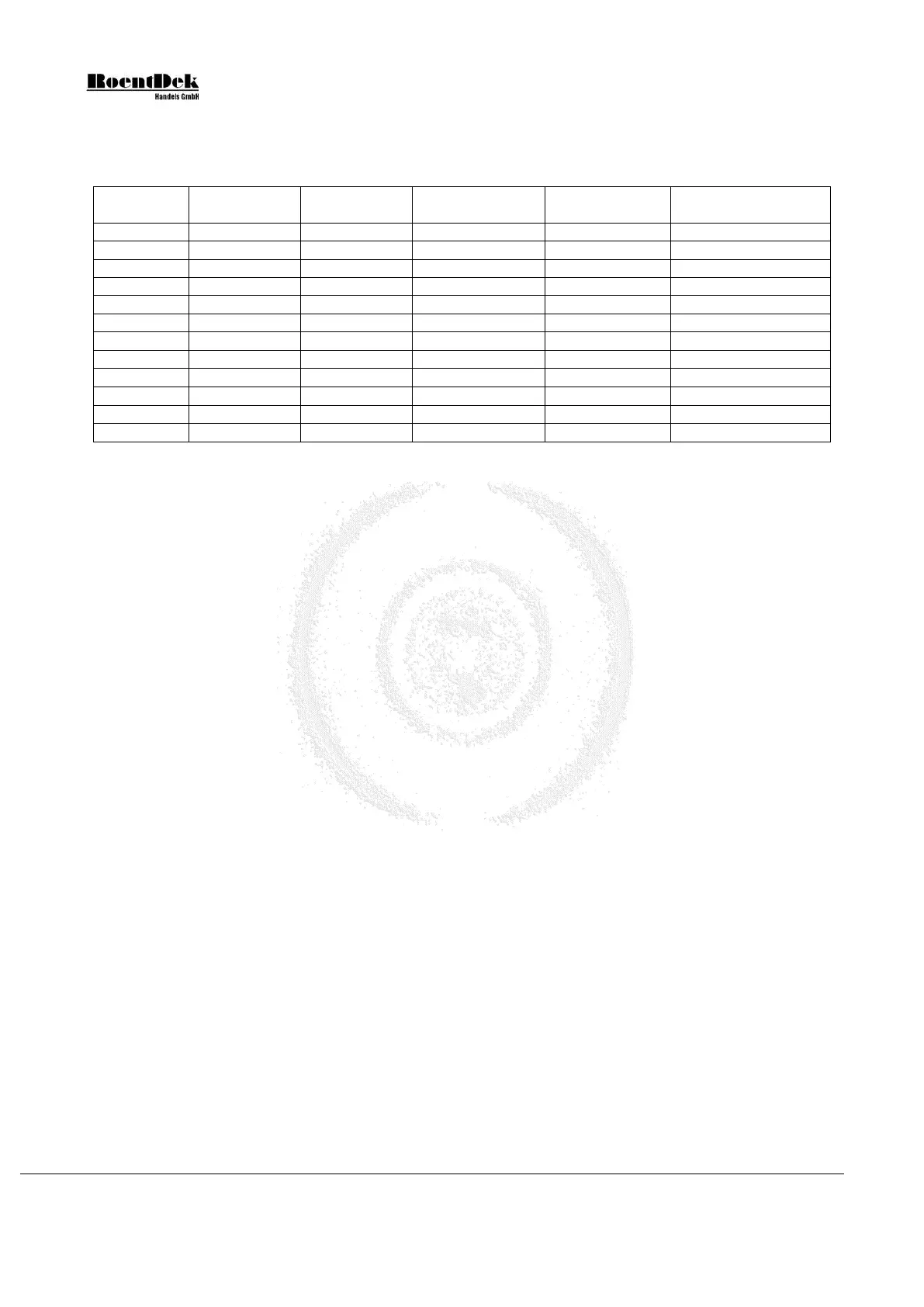
The red oval marks in Figure 2.3 define the pins for twisted cable pairs (1/4 and 3/2 pairs only for Hexanode). When connecting
the delay-line anode please give special attention to the assignment of neighboring pins 5 and 76 which are NOT attributed to
cable pairs from the same anode terminal, likewise for pins 1 and 2 in case of the Hexanode.
Table 2.2: FT12(TP) pin description for HEX detectors
Verify proper anode cabling with an Ohm meter. Check for
- proper resistance between the ends of all wires (e.g. between pin 5 and pin 7),
- absence of shorts of any wire to ground or to any other detector part,
- absence of shorts between any of the wires,
- absence of shorts between the other detector parts.
A “short” in this respect is any resistance < 10MΩ (except for the resistance between MCP back and front, which may be
smaller, see next section).
If you perform these checks from the air side of the feedthrough make sure to identify the pin numbers correctly (mirror-
inverted compared to Figure 2.3).
RoentDek can supply a test plug to ease this verification task. Some of the tests can be
done more efficiently via the
RoentDek signal decoupler plug (see next section). A cabling error which cannot be detected
by verifying the cables with an Ohm meter from the feedthrough air-side alone (e.g. when the parts in vacuum are not accessible
any more) is for example a swap between pin 6 and 8.
If a connector pin is too close to the chamber wall or a neighboring pin, this may result in a discharge during detector operation,
with consequences to the electronics and detector (see above). In case of DLD please give extra attention to pins 1 and 2,
which can have especially high potential relative to the others.
2.3 The FT12TP (hex) – Feedthrough Flange with Signal Decoupler
The FT12TP feedthrough and signal decoupling option allows using any adequate amplifier and timing discriminator or
recording electronics to operate a
RoentDek DLD (or HEX, see also FT16TP in the next section). Examples for adequate
amplifier/CFD are the
RoentDek ATR19 units or the FAMP1/3/6/8 (amplifier only, with output to CFD or fast-ADC
follow-up electronics).
The FT12TP for DLD contains the standard 12 pin feedthrough FT12 for the in-vacuum cables as described above and an
air-side connector plug. The plug provides adequate RC decoupling circuits and special transformer circuits to turn the
differential delay-line signals into single-line signals with 50Ω line impedance output connectors. The detector voltages are
supplied via SHB input cables sockets:
U
Reference
Reference wires’ bias
U
Signal
Signal wires’ bias
U
Holder
Anode-plate (Holder) bias, not in hex-version
U
MCP front
MCP front bias, not in hex-version
U
MCP back
MCP back bias, not in hex-version
U
X
optional “X” potential, can be used for a mesh or intermediate MCP bias, not in hex-version
Page 26 of 83 MCP Delay Line Detector Manual (11.0.1304.1)


 To Next Page