Reference Manual
00809-0100-4664, Rev BA
January 2010
Rosemount 8712
D-4
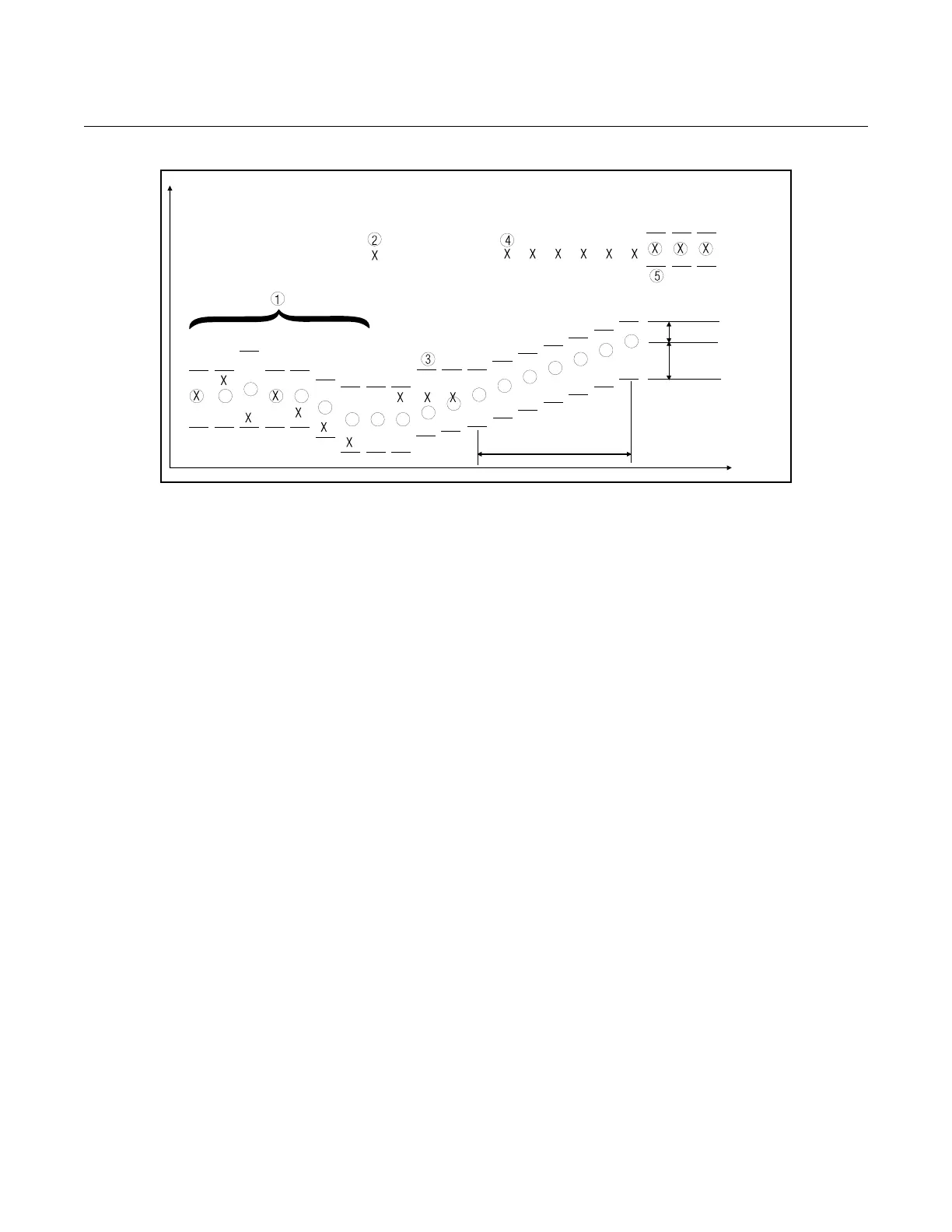
Figure D-1. Signal Processing
.
x: Input flow signal from sensor.
o: Average flow signals and transmitter output, determined by the “number
of samples” parameter.
Tolerance band, determined by the “percent limit” parameter.
– Upper value = average flow + [(percent limit/100) average flow]
– Lower value = average flow – [(percent limit/100) average flow]
1. This scenario is that of a typical non-noisy flow. The input flow signal
is within the percent limit tolerance band, therefore qualifying itself as
a good input. In this case the new input is added directly into the
running average and is passed on as a part of the average value to
the output.
2. This signal is outside the tolerance band and therefore is held in
memory until the next input can be evaluated. The running average is
provided as the output.
3. The previous signal currently held in memory is simply rejected
as a noise spike since the next flow input signal is back within the
tolerance band. This results in complete rejection of noise spikes
rather than allowing them to be “averaged” with the good signals as
occurs in the typical analog damping circuits.
4. As in Number 2
above, the input is outside the tolerance band.
This first signal is held in memory and compared to the next signal.
The next signal is also outside the tolerance band (in the same
direction), so the stored value is added to the running average as the
next input and the running average begins to slowly approach the
new input level.
5. To avoid waiting for the slowly incrementing average value to catch
up to the new level input, a shortcut is provided. This is the “time limit”
parameter. The user can set this parameter to eliminate the slow
ramping of the output toward the new input level.
Flow
Rate
Max
%
Limit
Time Limit
12 Samples = 1
Second
Time


 To Next Page