Page 9
Safety notes 1
User guide User profiles 1.1
Art. no.: 0-48-0227 Rev.: g
DEFIGARD/PHYSIOGARD Touch 7
1 Safety notes
1.1 User profiles
Physician The DEFIGARD
®
Touch 7 must only be used by qualified medical or paramedic staff,
if the manual defibrillation mode is activated.
The PHYSIOGARD
®
Touch 7 must only be used by qualified medical or paramedic
staff.
Other persons The DEFIGARD
®
Touch 7 can be used by other persons (AED mode only if trained
in early defibrillation).
Training An initial training of at least 30 minutes is necessary and sufficient to use the device.
1.2 Intended Use
The PHYSIOGARD
®
Touch 7 is a monitor.
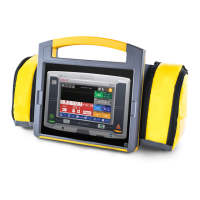
The DEFIGARD
®
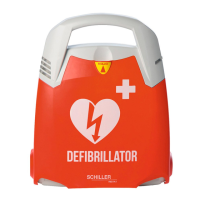
Touch 7 is an emergency monitor / defibrillator.
Defibrillator
The DEFIGARD
®
Touch 7 defibrillation function is used for the treatment of
ventricular fibrillation (VF) and ventricular tachycardia (VT).
Transcutaneous Pacemaker
The pacemaker pulse is delivered using the same electrode pads (adult or child)
as those used for defibrillation. The frequency and current of the pacemaker
pulses are defined by the user. There are two pacemaker modes as follows:
– Fix: The pacemaker pulse is delivered at a fixed frequency and current level de-
fined by the user.
– On demand: Current level and frequency are defined by the user. The unit mon-
itors the ECG signal and generates pacemaker pulses if the pulse rate falls be-
low the defined value.
Depending on their configuration, the monitoring function of the
DEFIGARD
®
Touch 7 & PHYSIOGARD
®
Touch 7 delivers the most important
parameters – ECG, SpO2, SpCO, SpMet, CO2 – and allows continuous
monitoring of the patient from the beginning to the end of an intervention.
The devices are intended for single patient use only.
The devices are designed to meet the specific needs of ground and air rescue
services as well as in-house and inter-hospital transportation.
The devices can be used for adults, children and neonates with the
corresponding accessories.
ECG
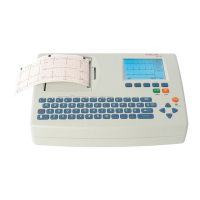
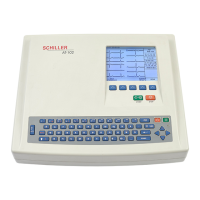
The ECG is used to diagnose cardiac abnormalities, acute myocardial
ischaemia and infarctions in chest pain patients.



 To Next Page