Stride Industrial Ethernet Switches User Manual 2nd Ed. Rev. B
Chapter 3 - Managed Switch Software Monitoring
• 64-octet Packets = The number of Ethernet packets received into this port that were 64 bytes in
length.
• 65 – 127-octet Packets = The number of Ethernet packets received into this port that were between
65 and 127 bytes in length.
• 128 – 255-octet Packets = The number of Ethernet packets received into this port that were
between 128 and 255 bytes in length.
• 256 – 511-octet Packets = The number of Ethernet packets received into this port that were
between 256 and 511 bytes in length.
• 512 – 1023-octet Packets = The number of Ethernet packets received into this port that were
between 512 and 1023 bytes in length.
• 1024 – 1518-octet Packets = The number of Ethernet packets received into this port that were
between 1024 and 1518 bytes in length.
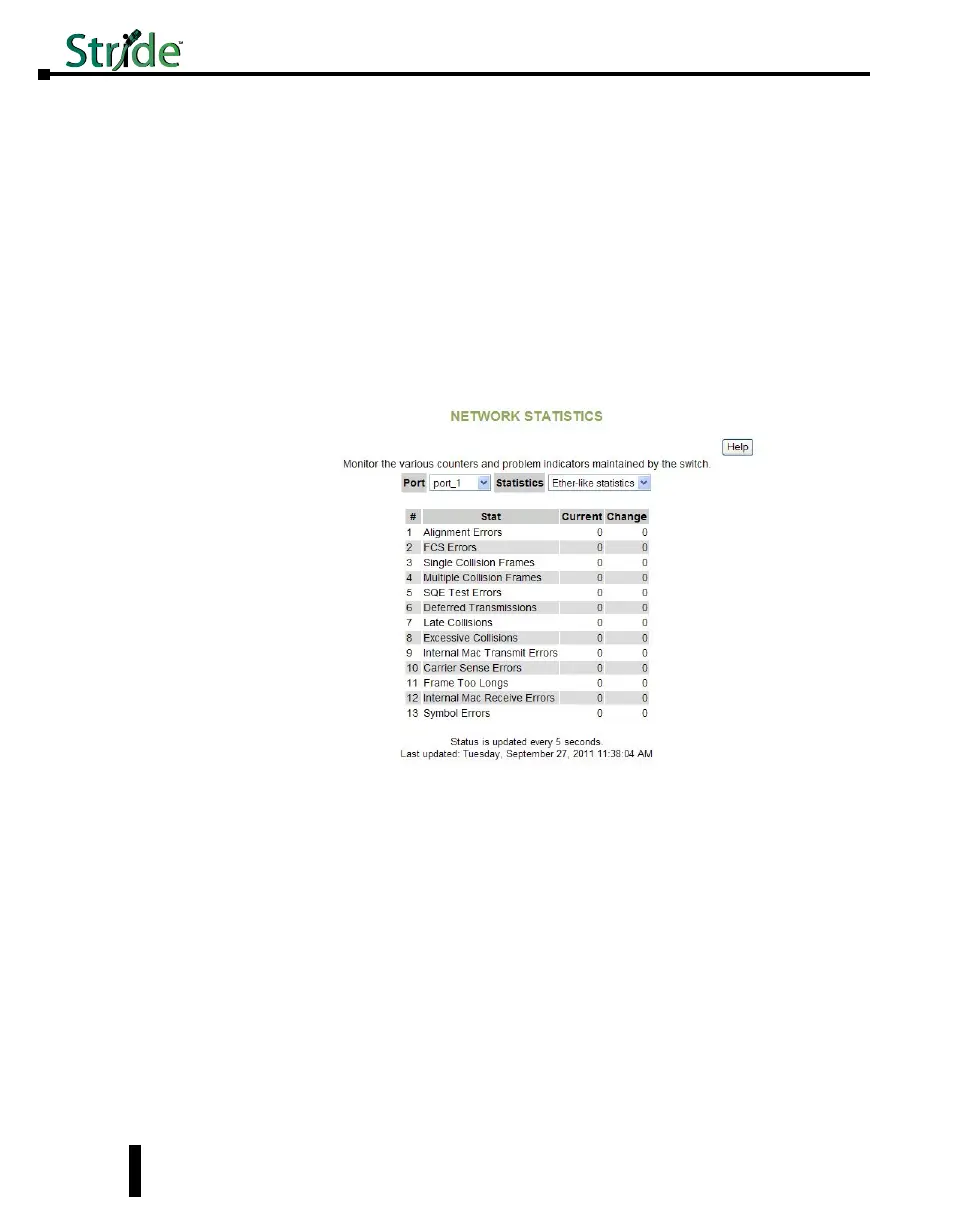
Ether-like statistics: The Ether-like statistics provide information on possible hardware,
electrical and/or noise problems on the network.
• Alignment Errors = These errors are more indicative of receiving the improper number of bits.
These errors are a good indication of noise and/or electrical problems. Check the wiring and
routing of cables in the event that many of these errors are seen.
• FCS Errors = This is the error that results from an incorrect CRC calculation. These errors along
with the Alignment Errors indicate noise and/or electrical problems. Check the wiring and routing
of cables in the event that many of these errors are seen.
• Single Collision Frames = This error occurs when only 1 collision occurs and the sending device is
able to send the packet on the subsequent attempt.
• Multiple Collision Frames = This error occurs when collisions occur on more than 1 attempt to
send a packet from a device.
• SQE Test Errors = The Signal Quality Error test verifies that the collision detection circuit is
working correctly. If the device does not detect the SQE test, this causes an error.
3-6


 To Next Page