Spanning Tree Protocols:
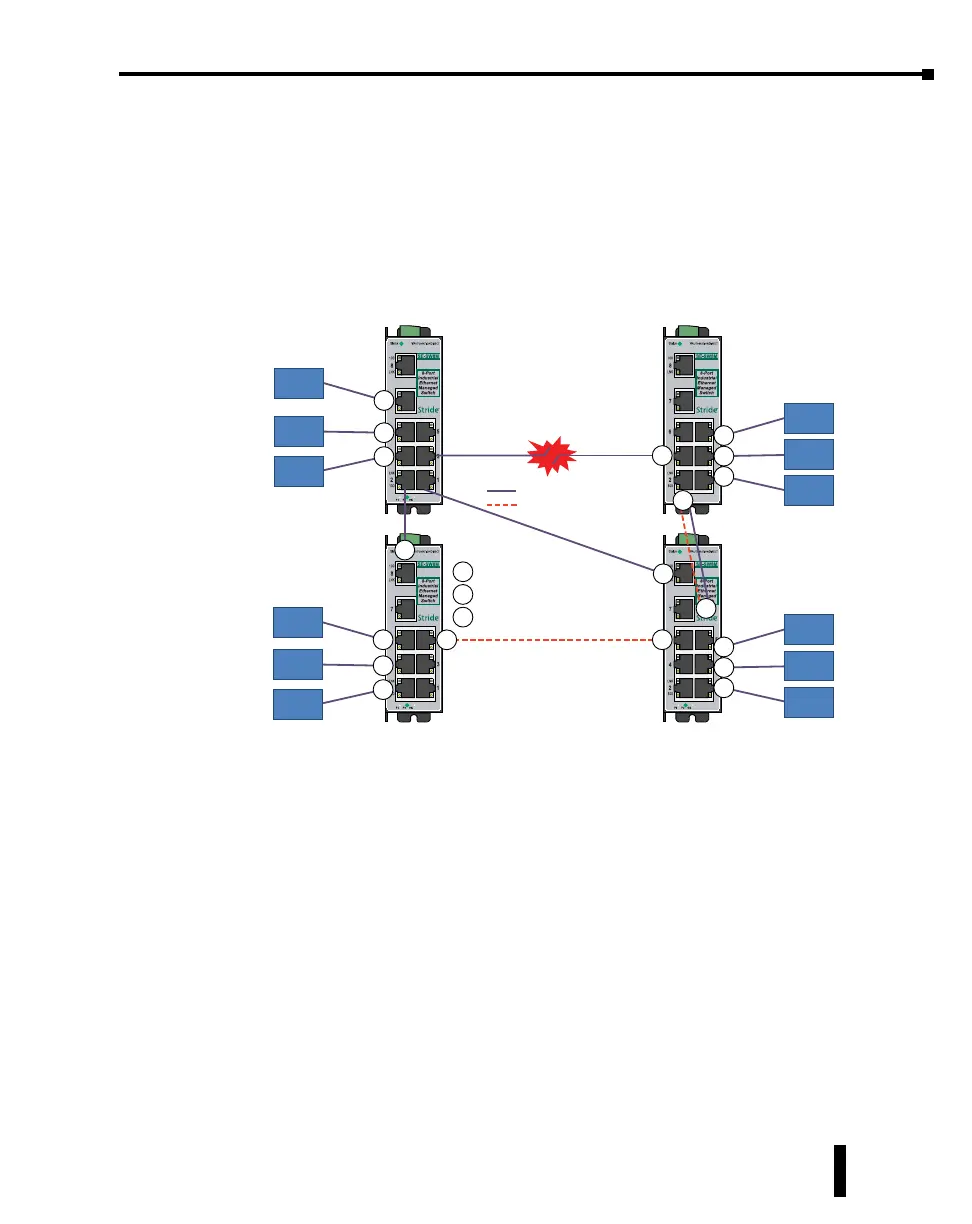
In the diagram below all the links are the same speed, 100 Mbps. The root ports are those
connected directly to the root bridge because they have the lowest path cost (only one hop).
The paths that must go through another bridge (switch) have a higher path cost (two hops)
and are designated as backup ports (decisions made internal to the switch by the Spanning
Tree Protocol). The ports connected directly to end stations are assigned as edge ports
(manually assigned on the Spanning Tree Port Settings page) so that RSTP doesn’t waste
time considering them.
End
Station
End
Station
End
Station
E
E
E
End
Station
End
Station
End
Station
E
E
E
End
Station
End
Station
End
Station
E
E
E
End
Station
End
Station
End
Station
E
E
E
R
B
B
B
R
B
R
= Root Port
= Backup Port
= Edge Port
B
R
E
Designated
Designated
Bridge
Bridge
Path
Failure
Active Path
Backup Path (blocked)
Backup path
activated after
root path
failure
The Rapid Spanning Tree Protocol provides a standardized means for intelligent switches
(also called bridges) to enable or disable network paths so there are no loops, but there is an
alternative path if it is needed. Why is it called Rapid Spanning Tree Protocol?
• ‘Rapid’ – it is faster than the previous (and completely compatible) version called Spanning Tree
Protocol (STP).
• ‘Spanning’ – it spans (connects) all of the stations and switches of the network.
• ‘Tree’ – its branches provide only one connection between two points.
In a Spanning Tree network, only one bridge (managed switch) is responsible for forwarding
packets between two adjacent LAN segments to ensure that no loops exist in a LAN. To
ensure that only one bridge is responsible, all other bridges on the network must cooperate
with each other to form a logical spanning tree that defines the pathways that packets should
take from bridge to bridge.
The logical spanning tree has exactly one bridge that is assigned the role of root. All of the
other bridges need to have exactly one active path to the root. The job of the root bridge
4-15
Chapter 4 - Managed Switch Software Setup
Stride Industrial Ethernet Switches User Manual 2nd Ed. Rev. A


 To Next Page