Manual 26166V1 MicroNet Simplex & MicroNet Plus
Woodward 116
8. If the readings are incorrect on several channels of the module, corresponding to both cables, replace
the module.
9. If replacing the module does not fix the problem, replace the FTM. The FTM contains only traces and
a few discrete components, so failure is extremely unlikely. See instructions for replacing the FTM in
Chapter 15, Installation (System Level Installation).
Recommendation:
The module should be returned to Woodward every 6 years for health
check and technical updates. This health check shall increase in
frequency when the module is more than 20 years old.
9.29—Speed/Analog IO Combo Smart-Plus Module
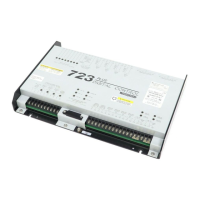
The Speed /Analog IO Combo Smart-Plus module is a MicroNet Plus module that will allow the customer
to access information about the module during operation via AppManager.
Firmware upgrade can be performed using Service Pack installation via AppManager.
9.29.1—Module Description
This module has four speed inputs that are configurable in GAP application as either MPU, Prox or Eddy
inputs.
The module contains circuitry for twelve analog inputs and four 4-20 mA outputs.
Analog inputs are configurable in GAP application as either 0-5Vdc voltage mode or 4-20mA current
mode. All inputs have 2-pole 10ms filter, except channels 11 and 12, which have 2-pole 5ms filter.
Note: When changing a GAP selectable input type the application must be saved and an application
restart is required. This allows both the hardware and software to initialize to the new input "type"
setting.
All 4-20 mA analog inputs may be used with two-wire ungrounded (loop powered) transducers or isolated
(self-powered) transducers. All analog inputs have 200 Vdc of common mode rejection. If interfacing to a
non-isolated device, which may have the potential of reaching over 200 Vdc with respect to the control’s
common, the use of a loop isolator is recommended to break any return current paths producing
erroneous readings.
Each board has an on-board processor for automatic calibration of the I/O channels. Each analog input
incorporates a time-stamping feature with 5 ms resolution for two low set points and two high set points.
These modules have no potentiometers and require no calibration. A module may be replaced with
another module of the same part number without any adjustment.
9.29.2—Specification
Table 9-4. Specifications
Number Channels: 4
Input Type: MPU/Prox/Eddy Detector (configured in GAP application)
MPU ratings
Input Frequency Range: 50 Hz to 25 KHz
Input Amplitude: 1 Vrms min, 25 Vrms max,
Input Impedance: 2000 Ω
or 6000 Ω over 80 to 2000Hz
Prox ratings
Input Frequency Range: 0.04 Hz to 25 KHz








 To Next Page