
 Need help?
Do you have a question about the 4RF Aprisa LTE and is the answer not in the manual?
Covers copyright, trademarks, disclaimer, RoHS/WEEE, FCC, and ISED compliance status.
Details hazardous location suitability and explosion hazard warnings for safe operation.
Provides RF exposure safety guidelines and antenna compliance requirements.
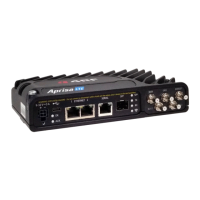
Describes the manual's scope, LTE product features, and key capabilities.
Details antenna, Ethernet, Serial, USB, SFP interfaces, and LTE architecture.
Explains supported applications like SCADA, Transportation, Smart City, and Networking.
Lists available LTE modules, network modules, processor, power options, and accessories.
Covers SIM installation, antenna attachment, power connection, earthing, and mounting.
Details initial software setup, upgrade methods (SuperVisor, USB, CLI), and bench testing.
Guides through connecting Ethernet, SFP, Serial, USB, and GPIO interfaces.
Provides steps for connecting to, logging into, and logging out of the SuperVisor interface.
Explains the SuperVisor interface layout and user privilege-based menu access.
Covers SIM card setup, operator selection, and PDN profile configuration.
Details carrier redundancy settings and link health check configurations.
Covers location summary display and general GNSS settings configuration.
Provides setup for Ethernet, SFP, Serial, USB, and WiFi interfaces.
Details logical interface creation, static routes, and routing table management.
Covers DHCP/DNS server settings and firewall rule configuration.
Explains how to configure QoS policies for traffic prioritization.
Covers DDNS, Date/Time, and Power Management settings.
Details security levels, user accounts, password policies, and RADIUS setup.
Covers VPN setup (GRE, IPsec) and SSH/HTTPS security configurations.
Provides SNMPv2/v3 configuration, access control, and user management.
Covers device reboot, factory reset, and saving/restoring configuration files.
Details alarm event types, history log, setup, action mapping, and SNMP traps.
Covers Syslog configuration and restoring event settings to factory defaults.
Provides summary of software versions and file transfer procedures.
Details monitoring of Terminal, Cellular, Ethernet, Serial, WiFi, VPN, DHCP, Firewall, Routes.
Explains connecting to CLI via SSH and lists available commands.
Covers SNMP agent configuration, MIB structures, and supported MIBs.
Lists specifications for LTE router, interfaces, protocols, and security.
Provides information on WEEE recycling program, disposal, and user responsibilities.
 General
| Category | Network Router |
|---|---|
| Power Supply | 10-30 V DC |
| Operating Temperature | -40°C to +70°C |
| Frequency Bands | 700 MHz, 800 MHz, 900 MHz, 1800 MHz, 2100 MHz, 2600 MHz |
| Interface | Ethernet, Serial |
| Channel Bandwidth | 5 MHz, 10 MHz, 15 MHz, 20 MHz |

 To Next Page
