3.1. Low Energy STANDBY Mode of the Power Supply
Now you can turn on the mains rocker switch marked ON/OFF (see Figure 2-4 | Rear panel - Connections, Pos.
(1)). This will activate only the low-energy STANDBY mode of the amplifier power supply and the red LED
above POWER button will light up (see Figure 3-1 | Front panel - Controls and Readouts, Pos. (b)), while the
main power supply is still off and the display is dark.
3.2. Front Panel
a) POWER button
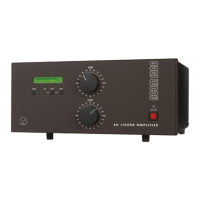
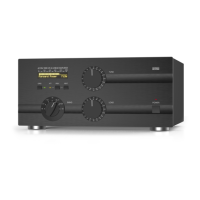
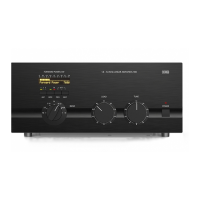
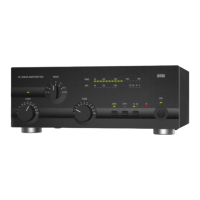
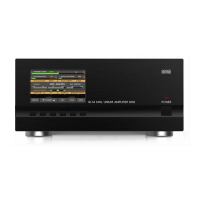
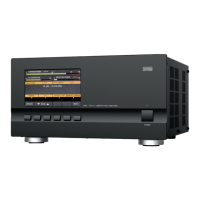
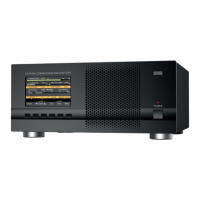
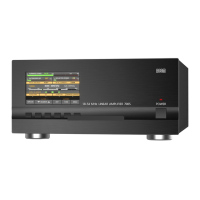
Please, see Figure 3-1 | Front panel - Controls and Readouts (Pos. (a).
When the rear panel mains rocker switch is turned on, push, and hold the POWER button for 1-2 seconds
to start the amplifier up. When the amplifier is turned on, push the POWER button to turn off the amplifier
(back to low energy STANDBY mode).
b) LED indicator above the POWER button
Please, see Figure 3-1 | Front panel - Controls and Readouts (Pos. (b).
When lit red and the screen is dark, the amplifier is in low energy STANDBY mode and may be turned on by
pushing the POWER button.
When you want to fully disconnect the mains power, switch off also the rear panel rocker switch (see Figure
2-4 | Rear panel - Connections, Pos. (1)). The front-panel red LED should go off and the POWER button will
become inoperative.
c) Functional buttons
Please, see Figure 3-1 | Front panel - Controls and Readouts (Pos. (c).
Six functional buttons keypad for manual (local) control of the amplifier. The function of each button is
indicated on the display above it. Depending on the displayed menu, the buttons may have different
functions (soft key).
d) A high resolution, 24-bit color display showing the operating information.
Please, see Figure 3-1 | Front panel - Controls and Readouts (Pos. (d).
3.3. Initial Turning On
In order to start up the amplifier, push and hold the front panel POWER button for one or two seconds.
About ten seconds later (boot sequence) the display will flash and show the basic screen with the amplifier
information (see Figure 3-2 | Basic screen).
The amplifier may start in either STANDBY or OPERATE mode depending on AUTO OPERATE user setting
(see Section 4.1.c) AUTO OPERATE user setting).


 To Next Page