Advanced RF Technologies, Inc.
1. INTRODUCTION
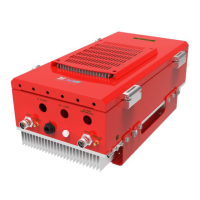
Up to four technologies in one body: SDR is an over-the-air repeater system that can incorporate up to four (4)
technologies in one body. Current supported technologies are SMR800, SMR900, PCS, BRS, Cellular, 700MHz, and
AWS.
1.1 Highlights
Supports up to 4 frequency bands simultaneously
- Available modules include:
700 MHz- Covers any combination of Lower A, Lower B, and Upper C
AWS- Covers 70 MHz
3 independent RF channels, each channel supports 1.25 to 18.75 MHz bandwidth
BRS- Covers 188 MHz, Instantaneous Bandwidth 30MHz
Cellular- Covers the 25 MHz band
SMR800 (18 MHz) / SMR900 (5 MHz)
PCS- Covers 65 MHz
3 independent RF channels, each channel supports 1.25 to 18.75 MHz bandwidth
Composite Output Power of 24 or 30,33 dBm
30 dB AGC Range @ 0.5 dB Step for SMR
40 dB AGC Range @ 0.5dB Step for 700MHz, AWS, BRS, Cellular, and PCS
Adjustable AGC Output Power Level
Adjustable ALC Level
Band Selectable via Web-GUI
Can Support up to 3 Non-Contiguous Bands on the PCS and AWS modules
Supports Network Management Monitoring System via SNMP
Digital filtering
Incremental Automatic Shutdown/Resumption Time: SDR gradually increases the time span between automatic
shutdown and resumption before it permanently shuts itself down
Versatility and Usability: SDR gives total control to the user. Most of the control parameters, e.g., gain, output
power, alarm threshold, etc. can be changed using the Web-GUI so that the user can adjust the system perfectly
to the given RF environment
Web-GUI connectivity via DHCP
Supports DHCP; No 3
rd
party GUI software required
Automated installation
Adjustable center frequencies by 1KHz step



 To Next Page