CHAPTER 3: USING UB25 WELDING FUNCTIONS
UB25 LINEAR DC RESISTANCE WELDING CONTROL
990-665 3-9
How It Works
Both constant current feedback and constant voltage feedback modes are limited in their ability to
deal with varying levels of part contamination and oxide. If constant current feedback were used,
the power supply would ramp the voltage to very high levels in order to achieve current flow through
the oxide. This rapid input of current is likely to cause splash, especially with round parts. Constant
voltage mode is not ideal for this purpose either, as the voltage will be restricted from reaching
sufficient levels to break down the oxide.
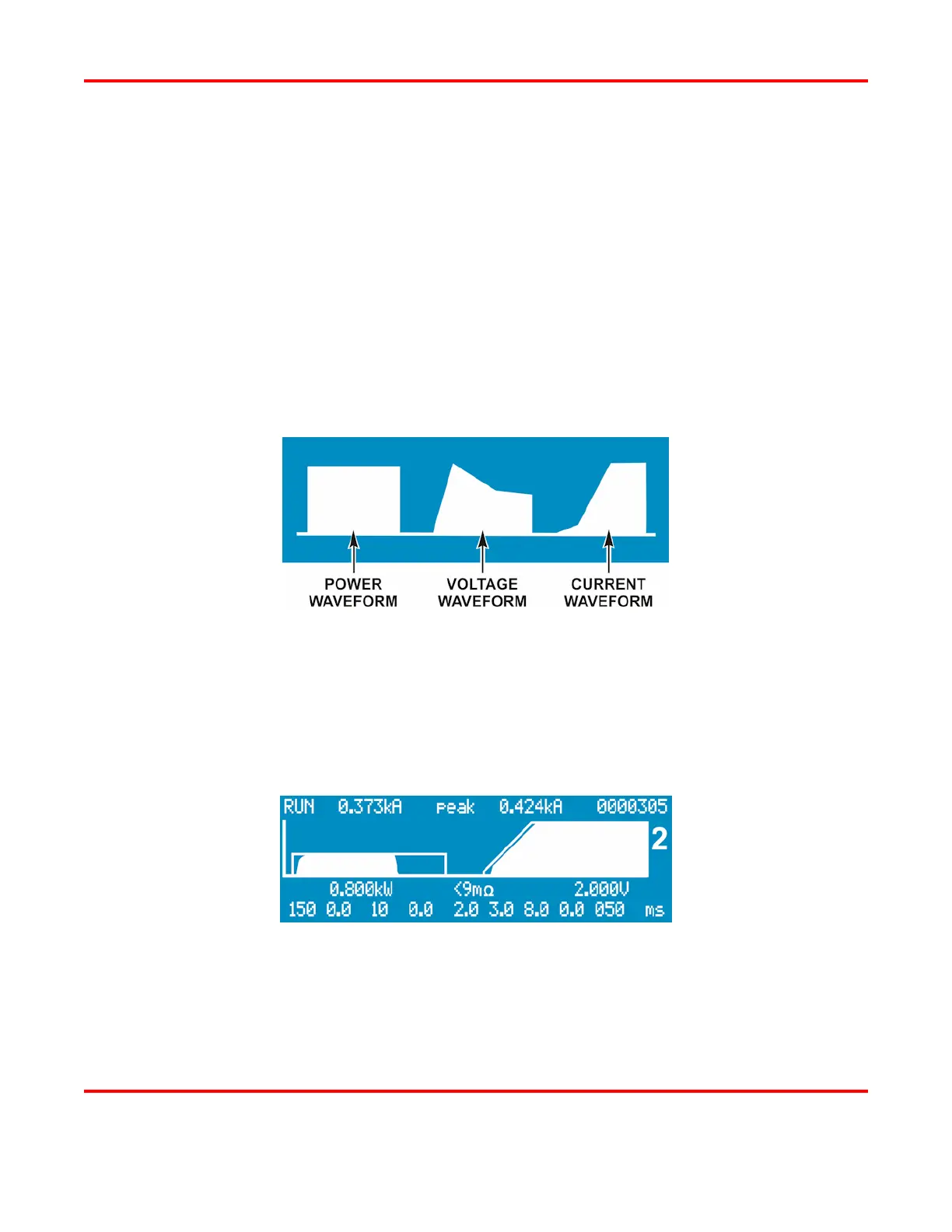
Constant power is ideal for this purpose. As the power supply tries to achieve constant power to the
weld, it raises the voltage to high levels early in the output waveform, since current cannot flow due
to the oxide. As the high voltage breaks down the oxide layer, more current flows to the weld and
the voltage and resistance drop. It will achieve this in a controlled fashion to maintain constant power
to the weld.
Constant Power Waveform with Corresponding
Voltage and Current Waveforms
Active Part Conditioning uses a dual-pulse output. The first pulse is programmed for constant
power, and the second for either constant current, constant voltage, or constant power. (Constant
voltage is used if there is still a chance of weld splash). The purpose of a dual-pulse operation is to
enable the first pulse to target displacement of oxides and good fit up, the second pulse achieves the
weld.
Active Part Conditioning Waveform



 To Next Page