Page 21
EVACU ELITE
INSTALLATION, COMMISSIONING AND USER MANUAL
4.2.5 Networking
4.2.5.1 General
The EvacU
ELITE
is capable of being arranged to function stand-alone, networked or a distributed
configuration.
For a networked or distributed configuration, a Network Interface Card (NIC) is required at each node.
The NIC supports fault tolerant (loop topology) connectivity between cabinets.
There are 4 different physical communication links supported:
• RJ45 Ethernet connection – where the cabinets are 100m or closer together – using CAT 5/6
UTP type cable.
• 2 Core UTP connection for distanced up to 1000m using VDSL technology. Requires SFP
OEM 3087 and OEM 3088 modules. Cat 5/6 can be used – only one pair utilised.
• Multi Mode Fibre optic – using dual fibre for distances up to 500m. Requires SFP OEM3097
• Single Mode Fibre optic – using single fibre (OEM3095 and OEM3096) or dual fibre
(OEM3094) for distances up to 10000m
VDSL – 2 core copper cable for distances up to 1000m
Single mode dual fibre – for distances up to 10000m See Note 1*
Single mode single fibre – for distances up to 10000m
Multi-mode dual fibre – for distances up to 500m See Note 1*
Note 1: * items not covered by LPCB certification at this point in time.
A network can be a mixture of the above physical communication links.
4.2.5.2 Network Interface Card
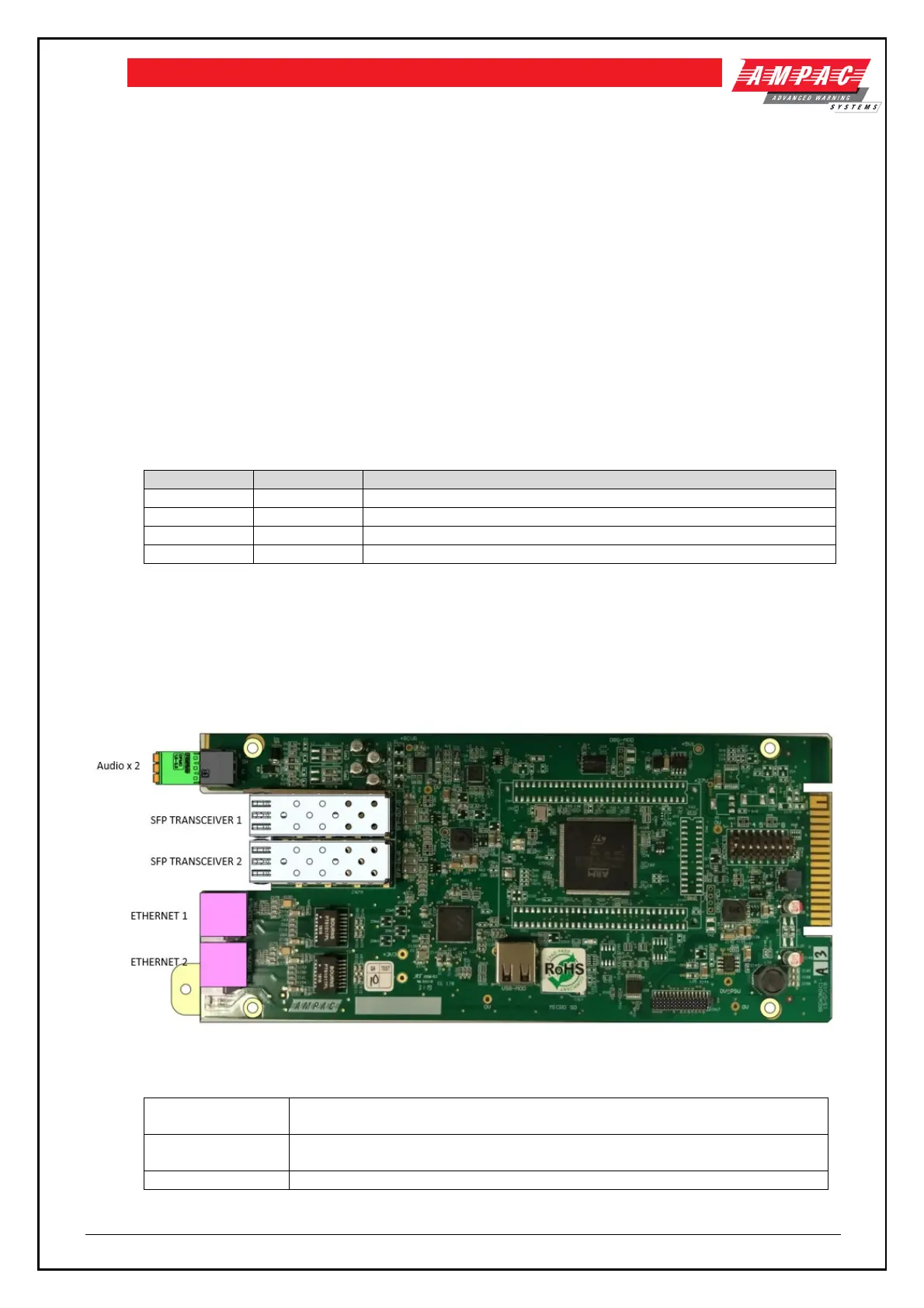
The NIC is connected to the DCPU to form a two-card stack. The NIC occupies slot 1 of the rack.
Figure 4-21 Network interface card
Analog line level audio input (hot, cold and shield), 10kΩ impedance, max
input +4dBu
These are small form-factor pluggable (SFP) transceiver sockets


 To Next Page