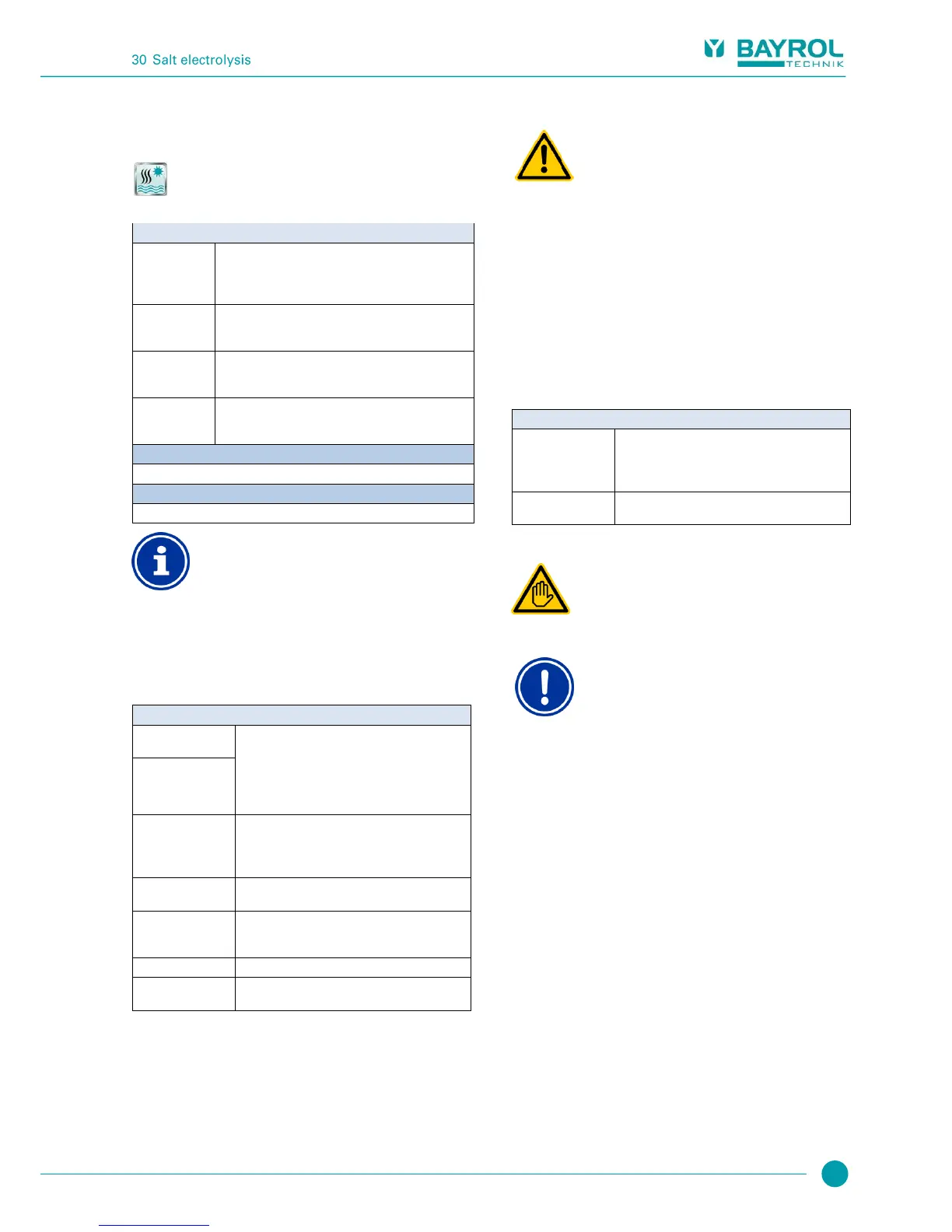
29.5 Menu Solar heating
The configuration menu for solar control is called up with the following
icon:
Solar heating
The following settings are available:
Solar Heating
Mode of
Operating
Inactive (solar control not used)
Solar off (solar control used, but turned off)
Solar always on (regardless of temperature!)
Auto (automatic temperature control)
Pool
Temperature
setpoint (Solar)
Desired pool temperature in [°C]
Temperature
hysteresis
(Solar)
Permissible tolerance range for temperature control in [°C]
Min. difference
solar → pool
Requisite temperature difference between solar
temperature and pool temperature to activate the solar
heating.
Basic settings for solar control.
Safety settings for solar control.
Allocation of a relay switch output
Solar control can only be activated if you have
allocated a relay switch output to it beforehand in the
Basic configuration menu.
29.5.1 Basic configuration
The menu Basic configuration is used to configure the basic settings
for solar control. This is generally done once at commissioning.
The following settings are available:
Sub-menu Basic configuration
The temperature inputs used for measuring pool
temperature and for solar temperature:
Inactive (function not used)
Temp. input 1 [3]
Temp. input 2 [4]
Temp. input 3 [5]
Relay switch output used for activating heating
(None / OUT 1 [26] / OUT 2 [27] / OUT 3 [30] /
OUT 4 [31] / pH+ [22] / pH- [21] / alarm [25]).
None Solar control is inactive
Cooling through the solar system can be enabled
here.
If an input is selected for this function, then the
heating output is turned off if the selected input is in
the state indicated.
Temperature sensor
configuration
Configure types and functions of temperature
sensors.
29.5.1.1 Frost protection
The frost protection function has already been described for heating
control.
For more information, see Heating Frost protection.
29.5.2 Safety settings
Hazard via remote access
In some circumstances, hazards may be yielded via
remote access to the solar control system, e.g.
scalding.
Potential consequence: Injury,
material damage.
Release of remote access to solar control is
expressly PROHIBITED for all applications in which
the safety of persons, animals, and property is not
completely guaranteed at all times and under all
circumstances; especially for remote access.
Safety is exclusively in the system operator's
sphere of responsibility.
The controller manufacturer disclaims all liability.
The following safety settings are available:
Inactive
Local network
Local network & Web
29.6 Electrical connection
Required user qualification:
ELECTRICAL SPECIALIST
Electrical connection of the solar control system may
only be performed by an ELECTRICAL SPECIALIST as
defined in the chapter User qualification.
Do not exceed the maximum currents
Do not exceed the maximum permissible electrical
currents for each individual relay switch output (max. 4
A) and for the sum of all relay switch outputs being
used in 230 V~ configuration (in sum, also max. 4 A)
Please also refer to the Chapter 230 V~ Power supply.
Depending on the type and model of the solar heating system, there
are various options for establishing the electrical connection (volt-free,
230 V~,...).
In general, the connection options already described for the universal
switch outputs are available, see Universal switch output
connection options.
30 Salt electrolysis
PoolManager
®
offers the option to control an external salt electrolysis
system.
For PoolManager
®
Cl or PoolManager
®
PRO, the current calculated
dosing rate for disinfection is converted into a control signal for the salt
electrolysis system. The control interface can be optionally realised
with trigger pulses or via a 4-20mA current output (optional).
The control system adjusts the salt electrolysis system's production as
needed. The higher PoolManager’s
®
current dosing output is, the
higher the salt electrolysis system's production is as well.



 To Next Page