4. Theory of Operation
4-46
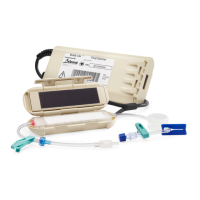
The diversion valve is used for closing and opening the patient line and
recirculation line. It contains a gear head and pincher. Hall effect sensors, on the
daughter board, sense a magnet that is mounted in the pincher to locate the
pincher position. The tubing is compressed between the pincher and the
sidewalls of the support housing. The patient line tubing passes across one side
of the pincher and the recirculation tubing on the other side. This allows for three
different valve positions; recirculation line open and patient line closed;
recirculation line closed and patient line open; and both lines open. The valve
motor is driven in both directions by computer commands. Because of the high
torque requirement when pinching the tubing, a 370:1 ratio gear head is used to
increase the motor torque. A bias current and the friction of the gear head keep
the pincher in position during steady state conditions.
The temperature probe assemblies (2) are mounted directly in the support
housing. One measures the input fluid temperature and one measures the output
fluid temperature of the heat exchanger. These are infrared (IR) sensors that
“look” into the fluid path through infrared transparent germanium windows on the
devices, and thin plastic film on the disposable set. The temperature probe
circuit board within each assembly contains a precision amplifier for the IR
sensor output. The voltage generated is proportional to the difference between
the temperature of the source and the ambient temperature of the device.
Device ambient temperature is measured by an integral thermistor. This data is
then manipulated by the computer board using constants arrived at during
calibration. The computer algorithm is capable of determining the temperature of
the fluid within the disposable set regardless of fluid or device temperature. It is
for this reason that the opening on the temperature block must remain clear of
debris.
The circuit breaker is designed to protect equipment, sub-system, and
components against the potentially catastrophic effects of electrical overload and
short circuit.
The power entry module is a 16 A, 250 V, capable of withstanding a 2000 VAC
dielectric strength for 1 minute. The AC line power enters the FMS2000 via a
removable power cord, which plugs into this connector.


 To Next Page