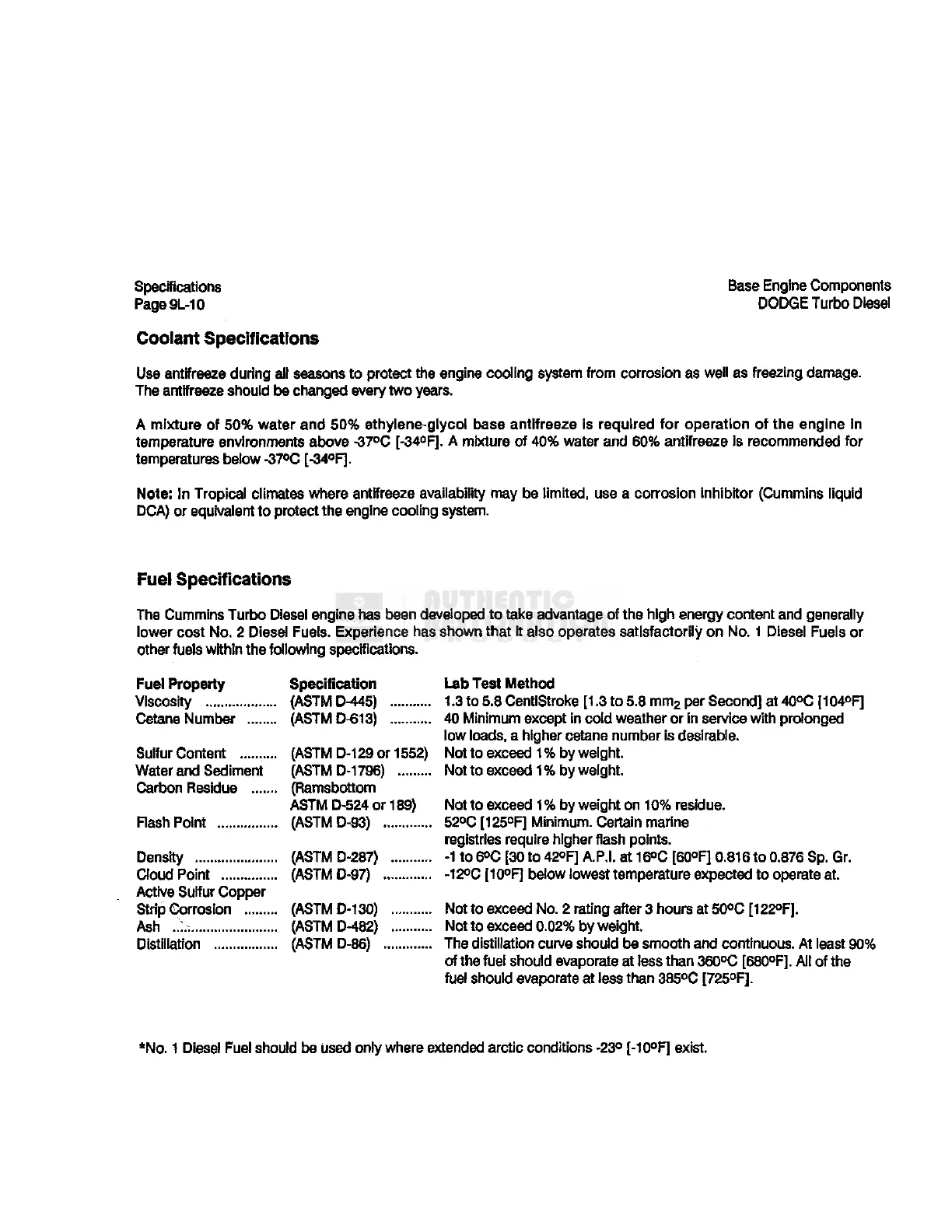
Specifications
Page9L-10
Base
Engine
Components
DODGETurbo
Diesel
Coolant
Specifications
Use
antifreeze during all
seasons
to protect the engine cooling
system
from
corrosion
as well as freezing damage.
The
antifreeze
should
be
changed
every
two
years.
A
mixture of 50% water and 50% ethylene-glycol base antifreeze is required for operation of the engine in
temperature environments above -37°C [-34°F]. A mixture of 40% water and 60% antifreeze is recommended for
temperatures below -37°C [-34°F].
Note;
In Tropical climates where antifreeze availability may be limited, use a corrosion inhibitor (Cummins liquid
DCA)
or equivalent to protect the engine cooling
system.
Fuel
Specifications
The
Cummins
Turbo
Diesel
engine has been developed to take advantage of the high energy content and generally
lower
cost
No. 2 Diesel
Fuels.
Experience
has
shown
that
it also operates satisfactorily on No. 1 Diesel
Fuels
or
other
fuels
within
the following
specifications.
Fuel
Property
Specification
Lab
Test
Method
Viscosity
(ASTMD-445) 1.3 to 5.8 CentiStroke [1.3 to 5.8 mm
2
per
Second]
at 40°C [104°F]
Cetane
Number (ASTMD-613)
40
Minimum
except in cold weather or in
service
with
prolonged
low
loads,
a higher cetane number
is
desirable.
Sulfur
Content (ASTM D-129 or 1552)
Not to
exceed
1
%
by weight.
Water
and Sediment
(ASTM
D-1796)
Not to
exceed
1
%
by weight.
Carbon
Residue
(Ramsbottom
ASTMD-524or189)
Not to
exceed
1% by weight on 10% residue.
Flash
Point
(ASTMD-93)
52°C [125°F]
Minimum.
Certain marine
registries
require higher
flash
points.
Density
(ASTMD-287)
-1 to 6°C [30 to 42°F] A.P.I. at 16°C [60°F] 0.816 to
0.876
Sp.
Gr.
Cloud
Point (ASTM D-97)
-12°C [10°F] below lowest temperature expected to operate at.
Active
Sulfur Copper
Strip
Corrosion
(ASTMD-130)
Not to
exceed
No. 2 rating
after
3
hours
at 50°C [122°FJ.
Ash
(ASTMD-482)
Not to
exceed
0.02% by weight.
Distillation (ASTM D-86) .............
The
distillation curve
should
be smooth and
continuous.
At
least
90%
(ASTM D-86) .............
of the fuel
should
evaporate at
less
than 360°C [680°F]. All of the
fuel
should
evaporate at
less
than 385°C [725°F].
*No. 1 Diesel
Fuel
should
be
used
only where extended arctic conditions -23°
[-10°F]
exist.





 To Next Page