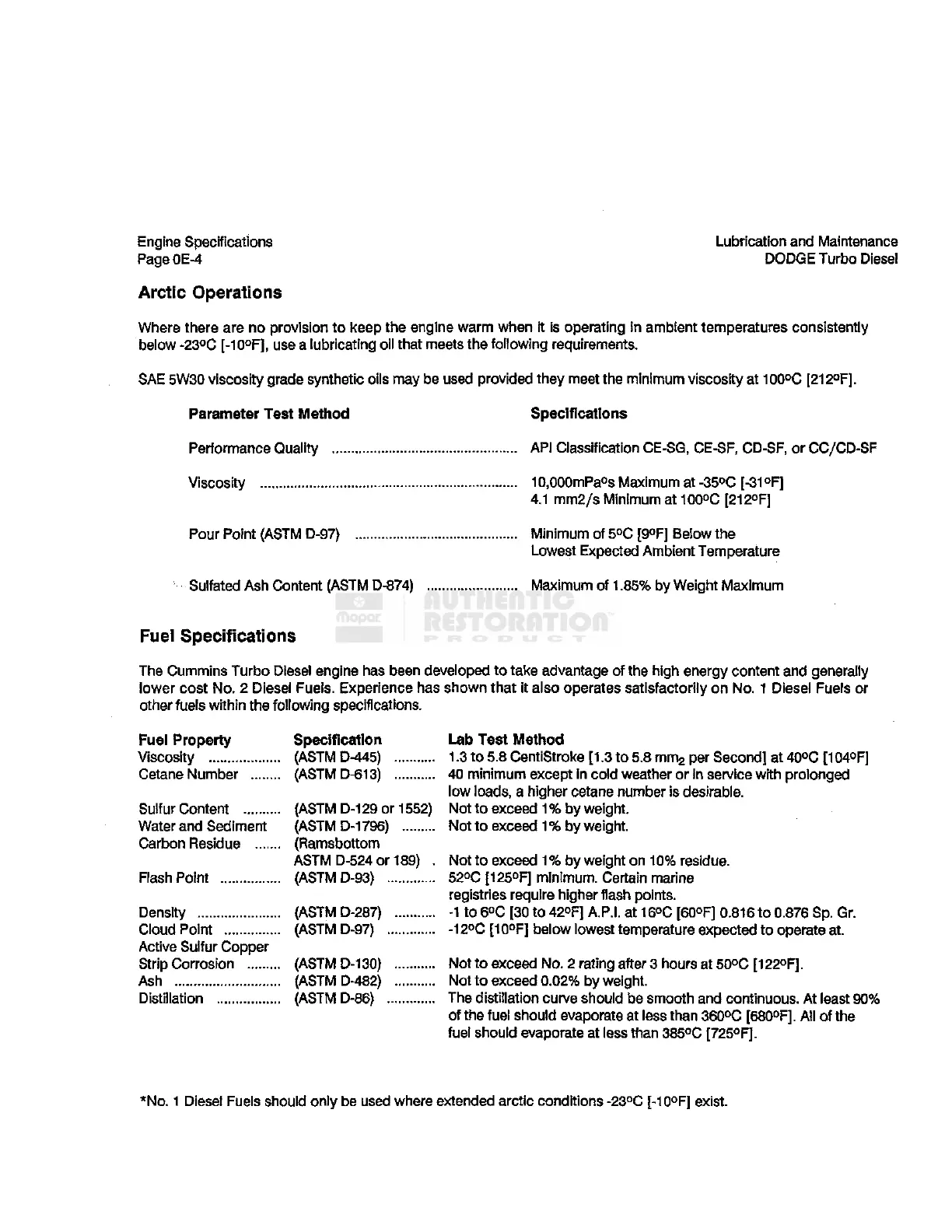
Engine
Specifications
Lubrication and Maintenance
Page
OE-4 DODGE Turbo Diesei
Arctic
Operations
Where there are no provision to keep the engine warm when It is operating in ambient temperatures consistently
below -23°C [-10°F], use a lubricating oil
that
meets the following requirements.
SAE
5W30
viscosity
grade synthetic oils may be used provided they meet the minimum
viscosity
at 100°C [212°F].
Parameter Test
Method
Specifications
Performance Quality API
Classification
CE-SG, CE-SF,
CD-SF,
or
CC/CD-SF
Viscosity
10,000mPa°s
Maximum
at -35°C [-31 °F]
4.1 mm2/s
Minimum
at 100°C [212°F]
Pour
Point (ASTM D-97)
Minimum
of 5°C [9°F] Below the
Lowest
Expected Ambient Temperature
Sulfated Ash Content (ASTM
D-874)
Maximum
of 1.85% by
Weight
Maximum
Fuel
Specifications
The
Cummins Turbo Diesel engine has been developed to take advantage of the high energy content and generally
lower
cost
No. 2 Diesel
Fuels.
Experience has shown
that
it also operates satisfactorily on No. 1 Diesel
Fuels
or
other fuels
within
the following
specifications.
Fuel
Property
Specification
Lab
Test
Method
Viscosity
(ASTMD-445)
1.3 to 5.8 CentiStroke [1.3 to 5.8 mrr^ per Second] at 40°C [104°F]
CetaneNumber ,..
(ASTMD-613)
40 minimum except in cold weather or in
service
with
prolonged
low
loads,
a higher cetane number is desirable.
Sulfur
Content
(ASTM D-129 or 1552) Not to exceed
1
% by weight.
Water
and Sediment (ASTM
D-1796)
Not to exceed 1% by weight.
Carbon
Residue
(Ramsbottom
ASTM
D-524
or 189) .
Not to exceed 1% by weight on 10% residue.
Flash
Point (ASTMD-93)
52°C [125°F] minimum. Certain marine
registries
require higher flash points.
(ASTMD-287)
-1 to 6°C [30 to 42°F] A.P.I. at 16°C [60°F] 0.816 to
0.876
Sp. Gr.
Cloud
Point
(ASTM D-97)
-12°C [10°F] below lowest temperature expected to operate at.
Active
Sulfur Copper
Strip Corrosion
(ASTM
D-130)
Not to exceed No. 2 rating
after
3 hours at 50°C [122°F].
Ash
(ASTM
D-482)
Not to exceed 0.02% by weight.
Distillation
(ASTMD-86)
The
distillation curve should be smooth and continuous. At least 90%
of the fuel should evaporate at
less
than 360°C [680°F]. All of the
fuel should evaporate at
less
than 385°C [725°F].
*No. 1 Diesel
Fuels
should only be used where extended arctic conditions -23°C
[-10°F]
exist.






 To Next Page