Fuel
System
DODGE
Turbo Diesei
Fuel
System
Malfunction -
Diagnosis
Page
14-11
Caution:
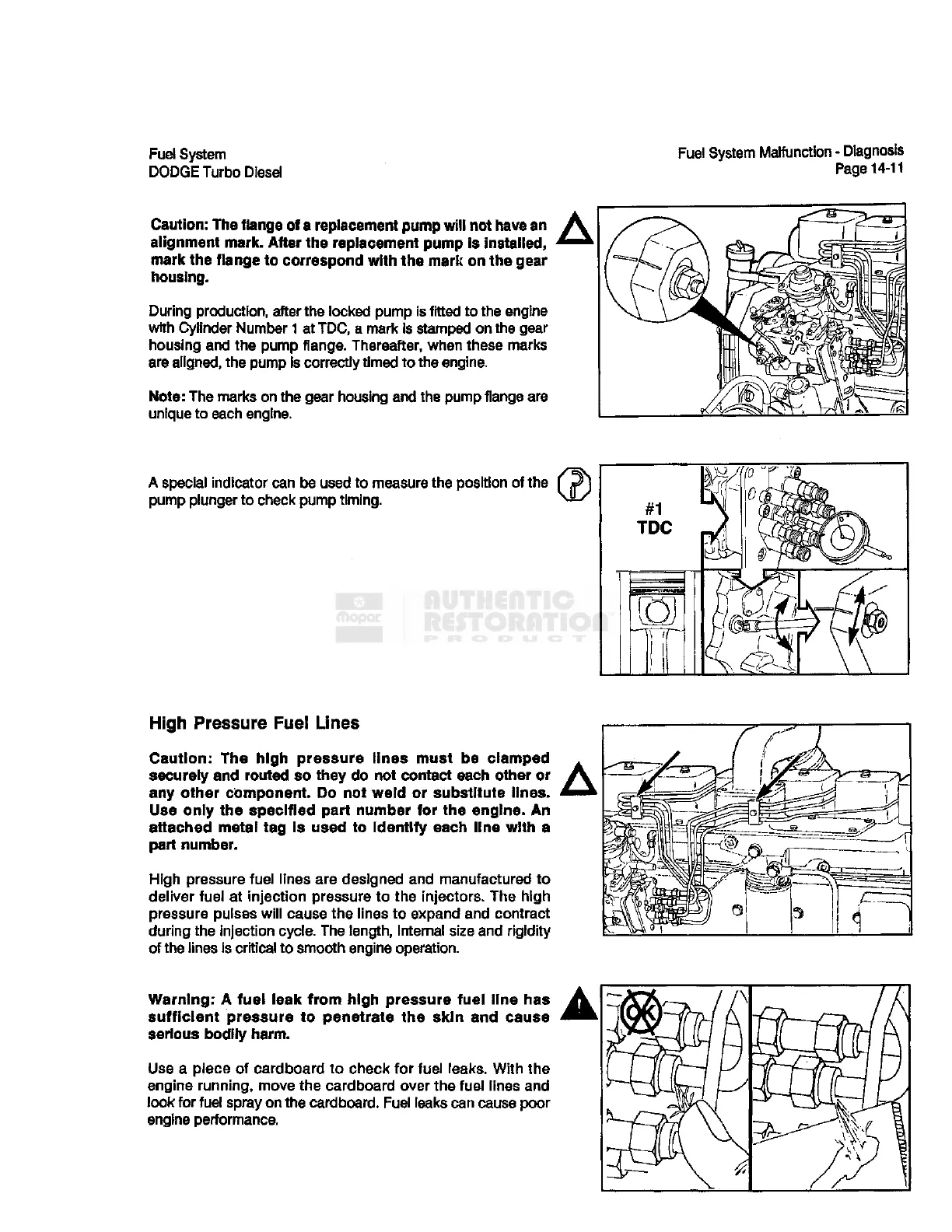
The flange of a replacement pump will not have an
alignment mark. After the replacement pump is installed,
mark the flange to correspond
with
the mark on the gear
housing.
During production, after the locked pump
is
fitted
to the engine
with
Cylinder Number
1
at
TDC,
a mark is stamped on the gear
housing
and the pump flange. Thereafter, when these marks
are
aligned,
the pump
Is
correctly
timed to the engine.
Note:
The marks on the gear
housing
and the pump flange are
unique to each engine.
A
special
indicator can be
used
to
measure
the position of the
pump plunger to check pump timing.
High
Pressure
Fuel
Lines
Caution:
The high pressure lines must be clamped
securely
and routed so they do not contact each other or
any other component. Do not weld or substitute
lines.
Use
only the specified part number for the engine. An
attached metal tag is used to identify each line
with
a
part number.
High
pressure
fuel lines are designed and manufactured to
deliver fuel at injection pressure to the injectors. The high
pressure
pulses
will
cause
the lines to expand and contract
during the injection
cycle.
The length, internal
size
and rigidity
of the
lines
is
critical
to smooth engine operation.
Warning: A fuel leak
from
high pressure fuel line has
sufficient pressure to penetrate the skin and
cause
serious
bodily harm.
Use
a piece of cardboard to check for fuel
leaks.
With
the
engine running, move the cardboard over the fuel lines and
look for fuel
spray
on the
cardboard.
Fuel leaks ran
cause
poor
engine performance.


 To Next Page