1019567 REV. 03 5
1.2 General Precautions
Take the following precautions before servicing the power supply, or setting DIP switches:
• Be sure the power switch is in the Off position before making any electrical connections
• To prevent the possibility of an electrical shock, always plug the power supply into a grounded
power source
• Power supplies produce high voltage. Before working on the power supply module, do the
following:
Turn off the power supply;
Unplug main power; and
Allow at least 2 minutes for capacitors to discharge.
• High voltage is present in the power supply. Do not operate with the cover removed
• High line voltages exist in the ultrasonic power supply module. Common points are tied to circuit
reference, not chassis ground. Therefore, use only non-grounded, battery-powered multimeters
when testing these modules. Using other types of test equipment can present a shock hazard
• Be sure power is disconnected from the power supply before setting a DIP switch
• Keep hands from under the horn. Down force (pressure) and ultrasonic vibrations can cause
injury
• Do not cycle the welding system if the converter is not installed
• When using larger horns, avoid situations where fingers could be pinched between the horn and
the fixture
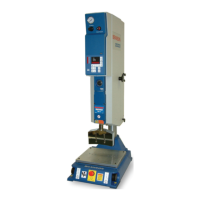
• Be aware that the Integrated Welder is “armed” if air pressure is indicated on the front panel air
pressure gauge
WARNING General Warning
If LED 1 or LED 2 on the Power Supply Module is lit, there is still High
Voltage present. Wait until they are out before servicing the welder.
Refer to Figure 3.4 2000IW/IW+ Ultrasonic Power Module for location
of LED 1 and 2.
CAUTION Loud Noise Hazard
Sound level emissions of up to 102 dB have been measured using a
standard test load. To prevent the possibility of hearing loss, use
appropriate hearing protection.
Sound level and frequency of the noise emitted during the ultrasonic
assembly process may depend upon a. type of application, b. size,
shape and composition of the material being assembled, c. shape and
material of the holding fixture, d. welder setup parameters and e.
tool design. Some parts vibrate at an audible frequency during the
process. Some or all of these factors may result in sound levels of up
to 102 dB. In such cases operators may need to be provided with
personal protective equipment. See 29 CFR (Code of Federal
Regulations) 1910.95 Occupational Noise Exposure. For all other
countries, follow your local regulations.



 To Next Page